This is a long Hints section - you may need to scroll down to
find the help that best matches your interest
Vector Algebra

Vector algebra can take a little getting used to. You'll need to
invest a bit of time, but if you do, you'll possess a really
powerful thinking tool with many important applications.
So what do the symbols like $\mathbf{a}$, $\mathbf{b}$,
$\mathbf{-a}$, $\mathbf{a + b}$, $\mathbf{a - b}$, $\mathbf{a +
2b}$, all stand for?
The letter $\mathbf{a}$ , typed in bold (or underlined when
hand-written), means a quantity of shift or displacement - a
specific distance in a specific direction.
In the problem we're doing here $\mathbf{a}$ will stand for the
quantity of shift from $C$ to $A$ and $\mathbf{b}$ will stand for
the quantity of shift from $C$ to $B$.
$\mathbf{a + b}$ means the combined effect, or total shift, when
$\mathbf{a}$ and $\mathbf{b}$ are both applied.
$\mathbf{-a}$ means the opposite of $\mathbf{a}$, that is the
shift that exactly undoes the effect of $\mathbf{a}$.
Important idea : if any two different vectors in the plane are
selected every other shift in the plane can be expressed as a
multiple (possibly a fraction and maybe negative) of the first
"base" vector combined with a multiple of the second "base"
vector.
Moreover, for any given shift there is only one multiples
combination using the specified "base" vectors which is
equivalent to it.
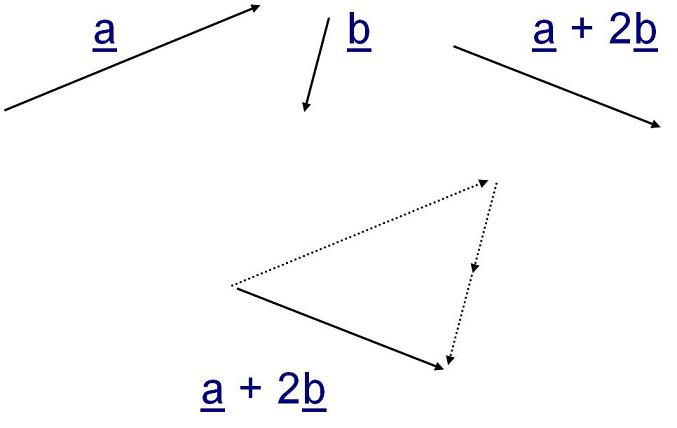
The illustration below shows a shift which is the combined effect
of a single $\mathbf{a}$ taken with $2$ lots of
$\mathbf{b}$.
 The two "base"
vectors must not be parallel of course, which would mean that one
"base" vector was just a simple multiple of the other, and that's
not really two different vectors in the sense required
here.
The two "base"
vectors must not be parallel of course, which would mean that one
"base" vector was just a simple multiple of the other, and that's
not really two different vectors in the sense required
here.
OK, back to the triangle.
The vertices are $A$, $B$, and $C$, with points $X$, $Y$ and $Z$
on the sides.
$X$ opposite $A$, $Y$ opposite $B$ and $Z$ opposite $C$.
The "base" vectors could be any pair but we'll take the shift $C$
to$A$ as vector $\mathbf{a}$ and the shift $C$ to $B$ as vector
$\mathbf{b}$.
The shift from $B$ to $A$ is the same as the joint effect of
$\mathbf{a}$ and $\mathbf{-b}$ together.
Displacement $B$ to $A$ is usually written as $\mathbf{a-b}$
rather than $\mathbf{a+ -b}$
$C$ to $Y$ is $\frac{2}{3}$ $\mathbf{a}$
$B$ to $Z$ is $\frac{1}{3}$ $\mathbf{(a - b)}$
The next two are a little harder:
$C$ to $Z$ is $\mathbf{b}$ combined with the $\frac{1}{3}$
$\mathbf{(a - b)}$ above and together they make $\frac{1}{3}
\mathbf{a} + \frac{2}{3}\mathbf{b}$ when simplified.
$B$ to $Y$ is $\frac{2}{3} \mathbf{a - b}$
Now let's put these vectors to work.
Remember the task : the internal lines are each in three parts
because they intersect each other. We have to show that these
intersections split each line in the ratio $3:3:1$
We will use vectors to describe the location of the point where
$CZ$ and $BY$ intersect.
First we describe all the points that lie on $CZ$, next we
describe all the points that lie on $BY$, then we see exactly
what it would require for a point to fit both those descriptions
and therefore be the point which lies on both lines.
The displacement vector from $C$ for any point along $CZ$ will
have this form :
$$\mu(\frac{1}{3}\mathbf{a}+\frac{2}{3}\mathbf{b})$$ where $\mu$
is just some fraction value (multiple)
Careful with this next bit:
The displacement vector from $C$ to any point along $BY$ is
$$\mathbf{b} + \lambda (\frac{2}{3}\mathbf{(a - b)}$$ $\lambda$
is just a multiplier, called a scalar, and works like $\mu$
The single $\mathbf{b}$ describes the displacement from $C$ to
$B$ then the extra shift moves the point up or down the line $BY$
from there.
We are after a point of intersection, so we're looking for a
point which fits both descriptions
$$\mu(\frac{1}{3}\mathbf{a}+\frac{2}{3}\mathbf{b})$$ and
$$\mathbf{b}+ \lambda(\frac{2}{3}\mathbf{a} - \mathbf{a}$$)
Using an idea from the beginning of this section : any
displacement expressed as a combination of $\mathbf{a}$ and
$\mathbf{b}$ will have its own unique pair of multipliers
(scalars).
So for point P, which is on both lines, the amount of
$\mathbf{a}$ will be the same in both descriptions, and likewise
the amount of $\mathbf{b}$.
We are looking for $\mu$ and $\lambda$ values so that
$$\frac{1}{3}\mu= \frac{2}{3} \lambda$$ (the quantity of
$\mathbf{a}$ must be the same) and$$\frac{2}{3}\mu = 1 -
\lambda$$ (the quantity of $\mathbf{b}$ must be the same)
The first equation tells us that $\mu = 2\lambda$. Substitute for
$\mu$ in the second equation to get $$\frac{4}{3}\lambda = 1 -
\lambda$
leading to $$\frac{7}{3}\lambda =1$$ or $$\lambda =\frac{3}{7}$$
and therefore $$\mu =\frac{6}{7}$$
This result means that $P$ is $\frac{6}{7}$ of the way along $CZ$
and $\frac{3}{7}$ of the way along $BY$
The point $P$ splits $CZ$ in the ratio $6:1$ and splits $BY$ in
the ratio $3:4$
We could now repeat the above process to find the intersection of
$AX$ and $CZ$ by considering displacement vectors from $A$. And
then continue to find the intersection of $BY$ and $AX$ by
considering displacement vectors from $B$. But the outcome would
be the same each time because it depends only on the ratio and
that hasn't altered.
The general result is that the line from any vertex, $A$, $B$ or
$C$, has two intersection points as it crosses the triangle. The
nearer one is $\frac{3}{7}$ along (as $P$ was along $BY$) and the
further one occurs $\frac{6}{7}$ along (as $P$ did along
$CZ$)
So the partition ratio for any of these three lines is
$3:3:1$
One last thought : new methods are often grasped a bit at a
time.
Don't be surprised if you have to run through this reasoning
several times, getting a little more from it each time.
Perhaps even have a rest and come back.
Working with someone else can often be helpful when you are
trying to follow something new.
When you think you have it, why not take a clean piece of paper
and try to write your own proof looking up as little as possible.
Dividing a line in a given Ratio (using only a straight edge
and a pair of compasses)
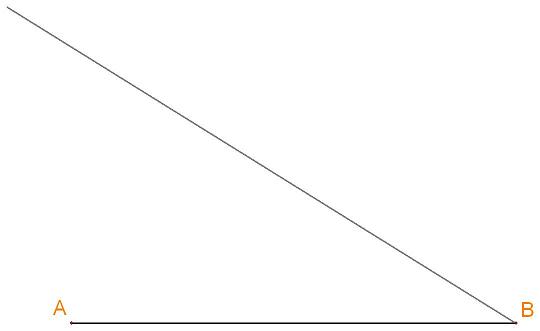
Suppose the line $AB$ is to be divided into three equal
parts.
Construct a line of any length from $B$ at any angle to $AB$.
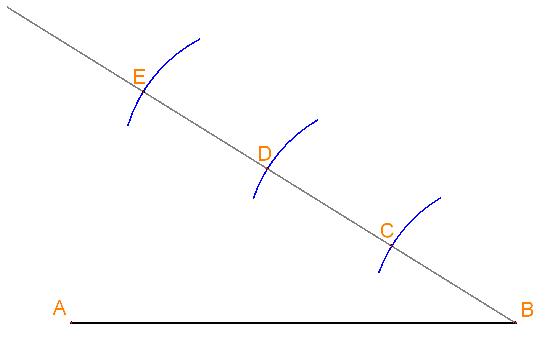
Open the compasses to any size setting and make three arcs
along the new line, starting from $B$ and stepping on from the
last arc to make the next.
These new intersections have been labelled $C, D$ and $E$.
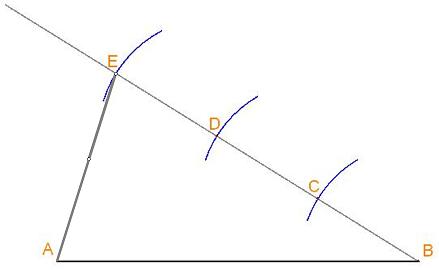
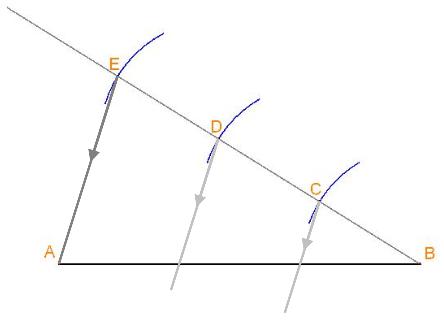
$E$ is now joined to $A$ and then lines parallel to $EA$ are
drawn from $C$ and from $D$, long enough to intersect the line
$AB$.
These lines cut $AB$ in the necessary positions for $AB$ to be
divided into the required three equal parts.
Parallel lines are consructed by replicating the angle
downwards fom $E$ to $A$, at point $C$ and point $D$.
If you need it, the next section will show you how to replicate
an angle without using a protractor to measure it.
Replicating an Angle using a pair of Compasses but not a
Protractor
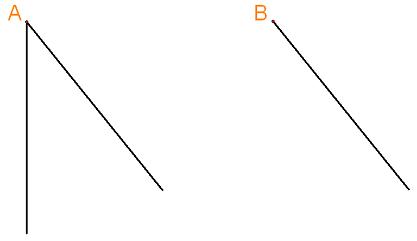
Suppose we need a line downwards from $B$ at the
same angle as the line downwards from $A$.
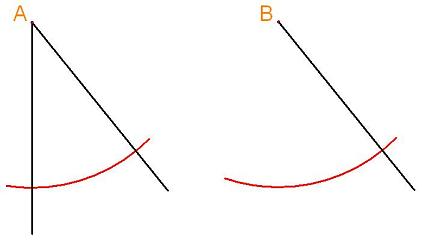
Step 1. Make any convenient setting of the compasses and sweep
an arc across both lines from $A$.
Step 2. With the same setting of the compasses sweep an arc
below $B$.
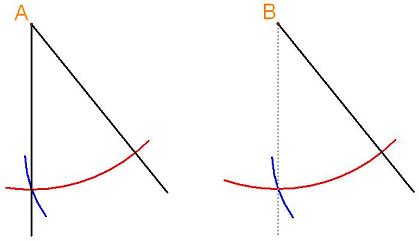
Step 3. Use the $A$ figure to set the compasses so that they
span between the two intersections of the arc with the lines
from $A$.
Step 4. With this new setting, place the point of the compasses
where the first arc (red) intersects the line from $B$ and mark
off an arc (shown in blue) to intersect that first arc.
Step 5. Join $B$ to this point to complete the figure.
Why exactly does this replicate the angle?
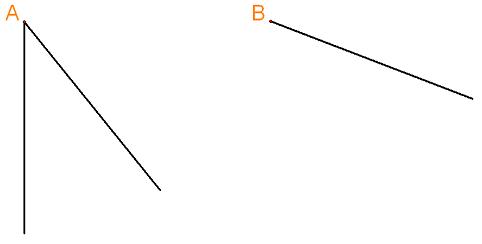
Practise a few times, including cases where the given line from
$B$ is not parallel to the corresponding line from $A$.