This solution was submitted by Michael of
St John Payne school. Does anyone have any other ideas?
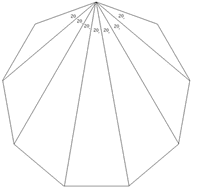
If we draw lines from a particular vertex to every other,
then the angle separating 2 adjacent vertices is 20°
<span class=ëditorial»(Can you explain this? == Ed.)</span>.
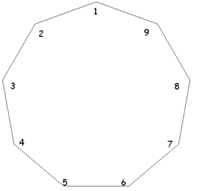
If we label the polygon as shown in the right hand diagram, the angle 416
is going to be two lots of 20° and therefore 40°.
This means that we have a general rule:
Angle ABC = 20*(|A-C|) when
A > C and A > B or A < C and A < B.
But this will only work for angles where B
isn't between A and C. For angles where B is between A and C we need to go the
long way round the polygon from A to C, or in other words the whole polygon
take away A to C. So we can come up with the rule:
Angle ABC = 20*( 9 - |A-C| )
for any angle where A < B < C or A > B > C.
E.g. Angle 124 = 20*(9 |1-4| ) = 20*6 = 120
We can use these rules to show that the angles in any quadrilateral ABCD on
the pegboard must add up to 360°.
If you rotate the peg board so that A is always at point 1 then ABC and BCD
will obey the second rule and CDA and DAB will obey the first rule.
Therefore
ABC + BCD + CDA + BAC
=
20*(9-|A-C|)+20*(9-|B-D|)+20*(|C-A|)+20*(|D-B|)
=
360.
We can also deduce that 2 opposite of the quadrilateral angles will add up to
180°: For quadrilateral ABCD,
where the pegboard is rotated so that point A is on peg 1,
Angle ABC will obey the first rule and Angle CDA will obey the second rule.
Therefore 20*( 9 - |A-C|) + 20*(|A-C|) = sum of to opposite angles
= 20*(9 - |A-C| + |A-C| ) = 20*9 = 180°!