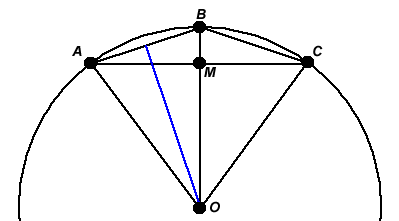
Chris from Saint John Payne School sent
in clear diagrams to explain the first part.
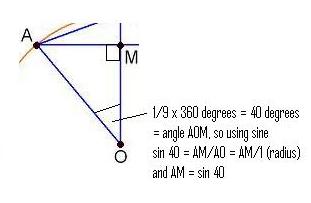
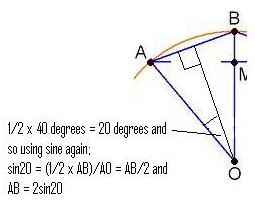
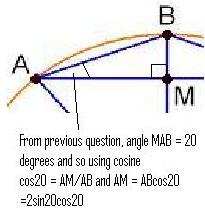
Diana thought about a general result.
Here's what she sent us.
In general, suppose that we've placed points A, B and C in such a
way that ÐA O B=ÐB O C=2q. I'm going to show that
sin(2q)=2sinqcosq. This is called a double angle
formula.
From triangle O A M, we know that A M=sin(2q) (as the circle
has radius 1).
From triangle O A B, we know that A B=2sinq (the blue line
bisects the angle at O and since triangle A O B is isosceles, the blue
line meets A B at a right angle, so we can think about two right-angled
triangles, each with angle q at O).
Since ÐA B O=90°-q (from the isosceles triangle A O B),
we know that ÐB A M=q, and so from triangle A B M we see
that A M=A Bcosq.
Putting together the last two paragraphs, we get
A M=2sinqcosq. But also A M=sin(2q), so
sin(2q)=2sinqcosq.