Well done Andrei from Tudor Vianu
National College, Bucharest, and Michael from Portsmouth for
sorting this one out.
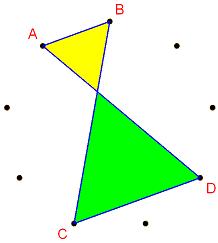
There are nine gaps and the top and bottom lengths on the "Figure of Eight" must be parallel. This means that the two sides, from top down to the bottom, must each cover the same number of pegs, because of the symmetry. Those sides could be 1, 2, or 3, but not 4 because that only leaves one gap (9-2×4) for top and bottom between them!
Working through those possibilities systematically : 1 for the sides leaves 7 (9 - 2) for the top and bottom : 1 with 6, 2 with 5, or 3 with 4.
2 for the sides leaves 5 (9 - 4) for the top and bottom : 1 with 4, or 2 with 3 3 for the sides leaves 3 (9 - 6) for the top and bottom : so just 1 with 2
Between two adjacent pegs the angle at the centre is 40° A chord between any two pegs and the centre of the pegboard makes an isosceles triangle. Split that triangle along its line of symmetry to get a right-angled triangle and
then use trigonometry to see that : when the pegs are n gaps apart, and the radius of the board is taken as 1, the length of the chord is 2sin20n°
AB is parallel to CD which means that both the yellow and green triangles have the same set of angles. So, because the yellow and green triangles are similar, the ratio of their areas is the square of the ratio for lengths. And, from the paragraph above, we know that the side lengths can always be calculated.
near 2 implies that (
must be near 2
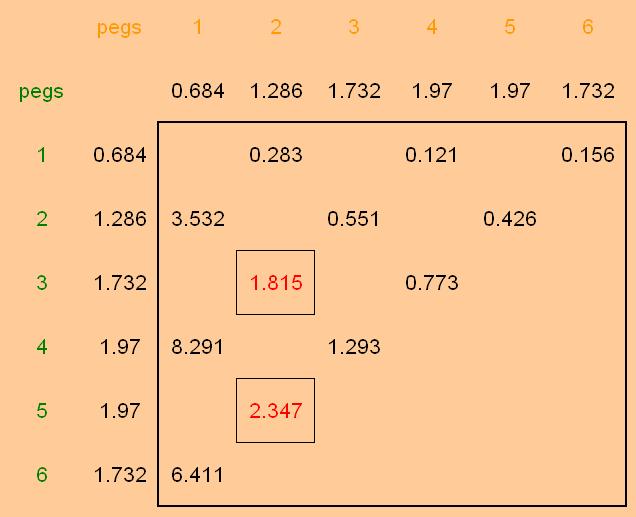
Along the top are the number of gaps on the pegboard that AB spans.
Down the side are the same for CD Beneath or beside each of those are the lengths calculated using 2sin20n°
The table shows the (
values.
The combinations that do not make a Figure of Eight with AB and CD parallel are blanked out. There are two values near 2 but 1.815 is the nearer so the solution is when yellow has two pegs and green has three pegs
Click here for a copy of the Excel file Figure of
Eight Results