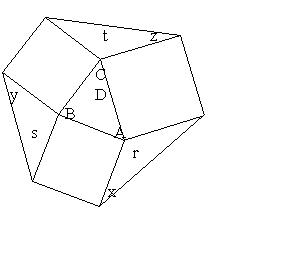
fig Aurel from King Edward VI School, Southampton, has proved Part (1) that the four triangles r, s, t and D have the same area.

Can you follow some of the suggestions given for the other parts and discover anything else?

Here is Aurel's solution:

Let the sides opposite angles A, B and C be a, b and c respectively. The length of each side of all three squares are therefore known.

Consider triangle D. Using the well known formula, the area of triangle D is given by:
Δ= 1 2 absinC= 1 2 bcsinA= 1 2 casinB

where all three versions of the formula are clearly equivalent because the labelling of the triangle was arbitrary in the first place.

Consider triangle s. The angle B* at B in this triangle can be found by considering that the angles around a point add up to 360o , so B* =360-90-90-B=(180-B).

Therefore, the area of triangle s is 1 2 acsin(180-B).

By exactly the same reasoning the area of triangle r is 1 2 bcsin(180-A) and the area of triangle t is 1 2 absin(180-C).

In general we know that sin(180-θ)=sinθ so:
the area of triangle s is 1 2 acsin(180-B)= 1 2 acsinB
the area of triangle r is 1 2 bcsin(180-A)= 1 2 bcsinA
the area of triangle t is 1 2 absin(180-C)= 1 2 absinC

So triangles r, s and t all have the same area as triangle D and so we have shown that all four triangles have the same area.

The problem has also been discussed on AskNRICH .