|
Curt from Reigate College has a neat way of proving this result by
rotating one of the triangles about C, keeping the other one fixed,
and then using similar triangles.
It is illuminating to see different methods and you may also like to
try proving this result using the Sine Rule.
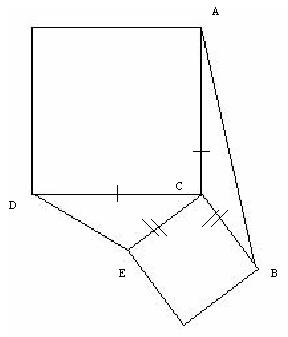
Here is Curt's method. The question specifies the construction of a line perpendicular to AB drawn through C, and continued until it intersects DE.It will be proven that the perpendicular to AB through C bisects DE. To prove this we first develop a useful tool. Note that Ð BCE=p/2, thus if we were to rotate B by p/2 radians counter-clockwise to B¢, then ECB' would be a straight line. Also we note that ÐACD = p/2. If we were to rotate A by p/2 counter clockwise to A¢, then A¢ would coincide with D as |CD |=|CA|=|CA¢|. |
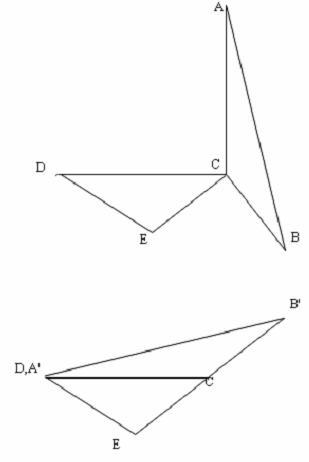
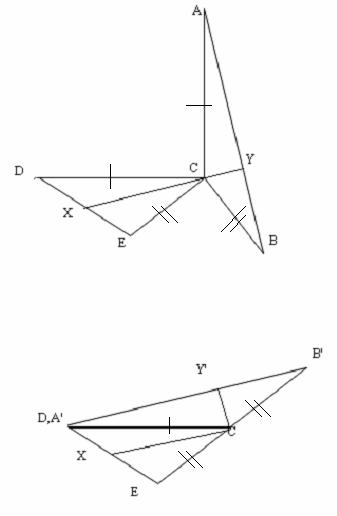
| The diagram shows the results of rotating triangle ABC by p/2 counter clockwise. As lengths between points are invariant under such rotations, |CA| = |CA¢|, |AB|=|A¢B¢| and |BC| = |B¢C| thus A¢B¢C is the same triangle as ABC. Clearly EDC is unaffected by the rotation; none of its vertices were rotated or translated. Now in order to see how this is useful, we start from the first diagram, and draw in the extended perpendicular from Y on AB passing through C intersecting DE at X. We repeat the rotation about C as shown in the next diagram. |
| In addition to the other transformations already discussed, Y goes to Y¢. XCY is a straight line perpendicular to AB, and Y is rotated p/2 about C to Y¢. Thus XCY¢ is a right angle and A¢B¢ is parallel to XC. Again, as the distances between points that are rotated in the same manner are invariant under rotation, it follows that |B¢Y¢|=|BY| and |A¢Y¢| = |AY|. It is out intention to show that |DX| = |EX|, or |DE| = 2|DX| |