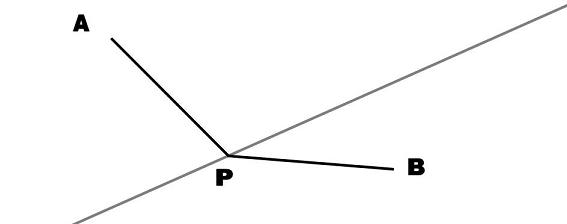
Draw a line (considered endless in both directions), put a point somewhere on each side of the line. Label these points
and
.
Use a geometric construction to locate a point,
, on the line, which is equidistant from
and
.
Can this point
always be found for any position of
or
?
If you believe that this is true how might you construct a proof?
If it is false, identify the circumstances when no point
, equidistant from
and
, exists.
Draw a new arrangement of one line and two points, one on each side of the line.
Imagine creating a collection of similar arrangements.
Can you suggest useful parameters which would uniquely define or identify each arrangement?
Parameters are the numbers ( measurements or ratios ) you might communicate to another person, say over the telephone, if you wanted them to produce exactly the same arrangement as your own.
These parameters define each arrangement.
Mark a point
somewhere on the line and express the length
in terms of your parameters.