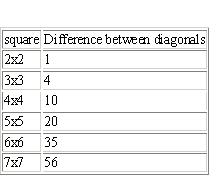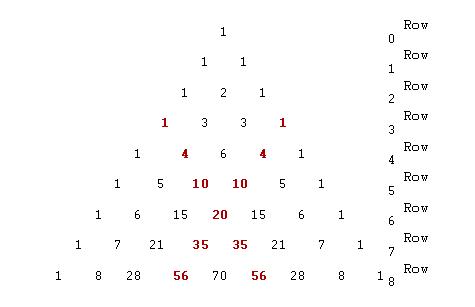
Well done to Maulik aged 11 who sent in some nice work on this problem. Neil's solution is given below.
For a 2 x 2 square with column headings of x and x+1, and row headings of y and y+1, Neil says that:
For the two by two square you can always express it algebraically like this: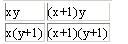
So the diagonal from top right to bottom left is:
(x+1)y+x(y+1) = xy+y+xy+x = 2xy+x+yLets call that Z.
The diagonal from top left to bottom right is:
xy+(x+1)(y+1) = xy+xy+x+y+1 = 2xy+x+y+1So the first diagonal is Z and the second Z+1 so the diagonal from top left to bottom right is always 1 more than the diagonal from top right to bottom left.
For a 3x 3square with column headings of x, x+1 and x+2, and row headings of y, y+1 and y+2, Neil says that:
The 3 by 3 square looks like this:
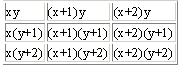
The diagonal from top right to bottom left is:
The diagonal from top left to bottom right is:
Let's say that
3xy+3x+3y = WThe diagonal from top right to bottom left is W+1.
The diagonal from top left to bottom right is W+5. So the difference between the diagonals is 4.More generally
Continuing with the same method: