Laura sent us her work on this problem.
Well done, Laura!
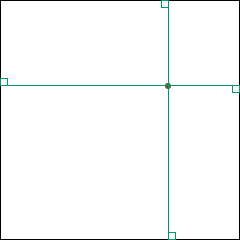
Let the square have side length l. Then its perimeter is 4l. Also,
we can see from the diagram above that the sum of the distances from the
point to the top and bottom sides is l, and similarly the sum of the
distances from the point to the left and right sides is l, so the
total sum of the distances is
, which is constant
and half of the perimeter.
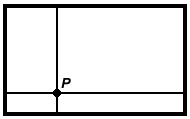
Let the rectangle have height h and width w. Then its perimeter is
2(h+w). This is very similar to the square. Here the sum of the
distances from P to the top and bottom sides is h, and the
sum of the distances from P to the right and left sides is w, so the
total sum of the distances is
is constant,
and again is half of the perimeter.
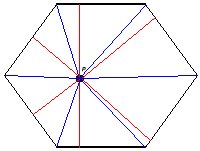
This hexagon isn't regular, but it is equilateral (all its sides have the
same length, l, say). I've drawn on the perpendicular lines (in red) from
P to the sides, and have also divided the hexagon into six triangles (in
blue),
each with base l and height the distance from that side to the point.
The area of the hexagon can therefore be written as
|
1
2
|
(sum of the heights)×l
|
. Since this is
constant, so is the sum of the heights.
In the same way, the sum of the distances in an equilateral pentagon is
constant.