Siobhan has sent us her work on this
problem. Well done, Siobhan!
The problem says that t82 has two cycles, whereas t83 has one
cycle and t84 has four cycles. I noticed that in each of these
examples the number of cycles in t8k is the highest common factor of
8 and k. I decided to test this on shuffles of lengths 9 and 10.
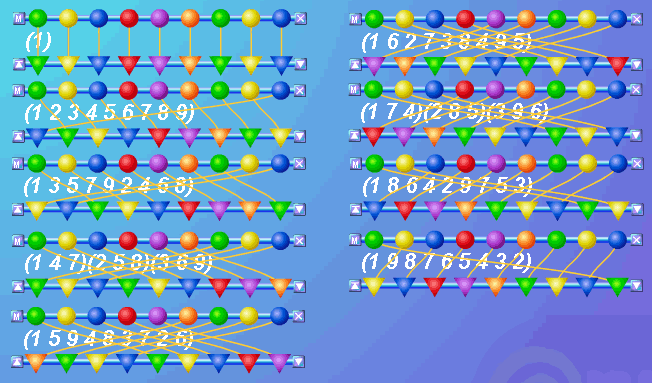
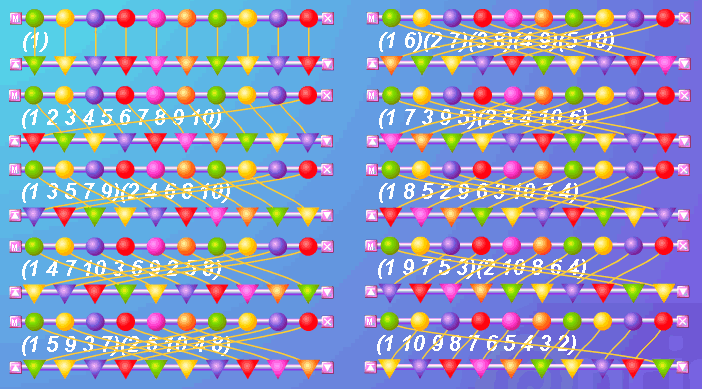
Here are the tables I got:
t90
=
(1)
t91
=
(1 2 3 4 5 6 7 8 9)
t92
=
(1 3 5 7 9 2 4 6 8)
t93
=
(1 4 7)(2 5 8)(3 6 9)
t94
=
(1 5 9 4 8 3 7 2 6)
t95
=
(1 6 2 7 3 8 4 9 5)
t96
=
(1 7 4)(2 8 5)(3 9 6)
t97
=
(1 8 6 4 2 9 7 5 3)
t98
=
(1 9 8 7 6 5 4 3 2)
t100
=
(1)
t101
=
(1 2 3 4 5 6 7 8 9 10)
t102
=
(1 3 5 7 9)(2 4 6 8 10)
t103
=
(1 4 7 10 3 6 9 2 5 8)
t104
=
(1 5 9 3 7)(2 6 10 4 8)
t105
=
(1 6)(2 7)(3 8)(4 9)(5 10)
t106
=
(1 7 3 9 5)(2 8 4 10 6)
t107
=
(1 8 5 2 9 6 3 10 7 4)
t108
=
(1 9 7 5 3)(2 10 8 6 4)
t109
=
(1 10 9 8 7 6 5 4 3 2)
This agrees with my prediction: the number of cycles in tnk is
the highest common factor of k and n. (Of course, (1)
really means (1)(2)(3)¼(n) so has n cycles.)
In tn1, consecutive numbers are 1 apart (1, 2, 3, ..., n).
When we do this twice, they are two apart, because, for example, 1 goes
to 2 which goes to 3 so 1 goes to 3. When we work out
tn3, the numbers that were 2 apart become 3 apart, because, for
example, 1 goes to 3 which goes to 4 so 1 goes to 4. It's quite
easy to see that this will keep happening, because each time we apply
tn we move the numbers 1 further apart. So in tnk the numbers
are k apart. But now we can see that the number of cycles we get will
be the highest common factor of k and n; this is like the Stars problem
mentioned in this question.