In
Sheffuls , you will find an introduction to the cycle
notation which you'll need to use for this investigation. The
Shuffles interactivity will also help. We're going to
investigate turns within turns. Watch out for those Zodiacal
alignments!
Let's start by generating all the permutations that can be made by repeating
the cycle (1 2 3 4 5 6 7 8) which we'll call t8.
In the Shuffles interactivity
you can do this by choosing the length 8 in the Flip and Turn Factory.
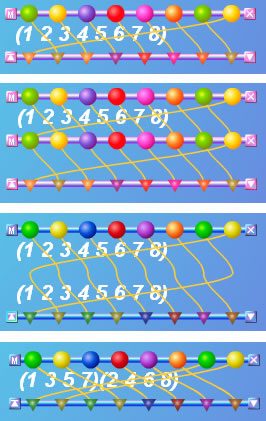
Pull down two copies of Turn 1 from the menu bar and compose them to obtain
Turn 2, as
illustrated in the diagram below:
There is also a
short tutorial that explains how to create and manipulate
shuffles.
Compose Turn 2 with another copy of Turn 1 and
you will have Turn 3. Keep going, and after tidying things up a bit
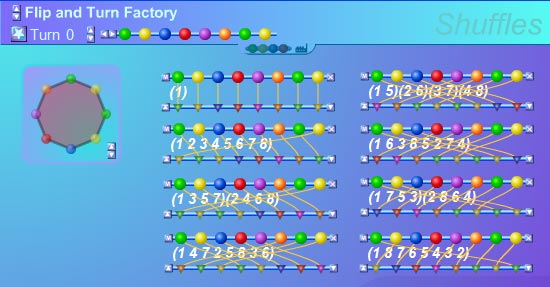
you should have all eight of them:
You can see how these shuffles relate to turns of the octagon by pressing
the bottom right play buttons.
In cycle notation you can make Turn 2 like this:
Think '1 goes to 2, and then 2 goes to 3; so 1 goes to 3'.
Then Turn 3 = t83 = (1 3 5 7)(2 4 6 8)(1 2 3 4 5 6 7 8) and so on.
You should end up with a similar table like this:
t0
=
(1)
t81
=
(1 2 3 4 5 6 7 8)
t82
=
(1 3 5 7)(2 4 6 8)
t83
=
(1 4 7 2 5 8 3 6)
t84
=
(1 5)(2 6)(3 7)(4 8)
t85
=
(1 6 3 8 5 2 7 4)
t86
=
(1 7 5 3)(2 8 6 4)
t87
=
(1 8 7 6 5 4 3 2)
Notice that t82 contains two cycles, but t83 contains just one,
and t84 contains 4. Why might this be?
Investigate what happens with length 9 and length 10 cycles. As a check,
you should find that t93 contains 3 cycles, but t92 contains just one.
Can you find a general rule? How many cycles will t232 contain?
How many cycles will t3010 contain?
Now look at
Stars . Notice anything?