Infinity is not a number, and trying to treat it as one tends to
be a pretty bad idea. At best you're likely to come away with a
headache, at worst with the firm belief that 1 = 0.
You may have met various ``paradoxes'' that play on this fact (and
our instinct to ignore it) before. An infinitely long line, for
instance, is surely infinitely many centimetres long. It's also,
equally surely, infinitely many miles long. But each centimetre is
a great deal shorter than each mile, so does this mean an
infinitely long line is two different lengths at once?
The answer, of course, is to assert confidently that the question
is meaningless (and, if you're in the mood to be unkind, just
shows how little the asker knows about proper mathematics)
and then go back about your business untroubled by such silly
quibbles.
Or, as I will hopefully convince you over the course of this
article, the answer is a simple ``No.''
Counting the natural numbers
We shouldn't treat infinity as a number. We can't count up to it,
and if we have an infinitely large set we will never be able to
count all of the objects in it.(A set is a collection of objects.
They can be any sort of objects, although generally mathematicians
use them to talk about mathematical objects, such as numbers. An
infinitely large set is, of course, one containing infinitely many
objects. It seems strange, therefore, to talk about certain
infinitely large sets being ``countably infinite'', but that is
indeed what I'm about to do.
Consider the natural numbers (the positive, whole numbers: 1, 2,
3, ...).
There are infinitely many natural numbers (if there were only a
finite number of them, there would have to be a largest natural
number - what would happen if we added 1 to that number?) so the
set containing all the natural numbers must be infinitely large.
We'll never be able to count them all. However, we can list
them in such a way that if we counted forever, we'd be sure not to
miss any out.
The natural numbers are what we use for counting anyway, so we can
think of them as coming ready-listed. There is an obvious starting
point (1) and a sensible order (1, 2, 3, ...).
To illustrate what I mean by a sensible order, imagine what would
happen if we tried to count the natural numbers randomly. However
long we counted, we'd never be sure we'd counted them all - we
could check for individual numbers in our random list, but we'd
never know if they were all there, or when (if ever) we were going
to reach a particular one.
Now imagine what would happen if we tried to count the natural
numbers by counting the odd numbers first and then the even ones.
We'd count forever, and never start counting the even numbers.
However, if we count them in the order given, we'll know once
we've reached 100 that we've counted everything between 1 and 100
once and only once. We might never reach the end (in a finite
time, at least) but we'll know we've not missed anything on the
way and that it's just a matter of time before we reach any given
number.
That is, the only thing stopping us from counting them all is that
we'll run out of breath before we run out of numbers. The proposed
method of counting them all is sound, just impractical. This is
what we mean by saying the natural numbers are countably infinite.
In much the same way, any infinite set of numbers that can
be put in a sensible, systematic order with a clear beginning such
that we're sure to get everything if we count forever is thought
of as countable.
Counting other sets
When we talk about comparing the sizes of two sets that contain
finite numbers of objects (a set, C, containing some cats and a
set, M, containing some baby mice, say) then one way to do so is
to match each object in one set with exactly one object in another
set and see if we have any left over. For the sets C and M, we
can instruct each cat to catch exactly one baby mouse - no sharing
allowed, nor hogging more than one mouse, nor letting one escape
if the cat doesn't already have another one.
If each cat does catch exactly one baby mouse - no more, no fewer
- we know there are (or, at least, were) the same number of cats
as mice. That is, the sets C and M were the same size. If any
cats go hungry, there were more cats than mice (C was larger
than M) and if any mice go free, there were more baby mice than
cats (M was larger than C).
This is called putting the objects into one-to-one correspondence,
and the same can be done when comparing the sizes of infinite
sets.
Another way of thinking about countably infinite sets is that they
are those sets whose objects can be put in a one-to-one
correspondence with the set containing the natural numbers only.
That is, if for each element in the set of the natural numbers
there is exactly one - no more, no fewer - element in the
set we're trying to count, then the set is the same size as the set
containing the natural numbers: countably infinite.
Putting the elements of an infinite set in sensible, systematic
order with a clear beginning such that it's just a matter of time
before we reach any particular element is, in fact, the same thing
as putting those elements in one-to-one correspondence with the
natural numbers.
If the natural numbers are the cats from the above illustration
and the elements to be counted are the baby mice, then the cats
already have an order to line up in. Lining the mice up next to
them so none escape and none are eaten together (putting them in a
sensible order) is the same as allotting the cats their dinner
(putting the elements of the two sets into one-to-one
correspondence).
Are the integers (all the whole numbers: ..., -2, -1, 0,
1, 2, 3, ...), therefore, countable?
At first, you might think not. First we need to find a sensible
beginning, and that may not be obvious. With the natural numbers,
we just started at the smallest and worked up. But the integers
don't have a smallest number (just as before, when showing there
was no largest natural number, think to yourself: if there were a
smallest integer, what would happen when we subtracted 1 from
it?), so where can we begin?
Say we start at 1 and work up, as before with the natural numbers.
Then we count 1, 2, 3, ..., putting them into one-to-one
correspondence as follows:
| Natural numbers | 1, | 2, | 3, | ... |
| Integers | 1, | 2, | 3, | ... |
Here, the problem is however long we count for, we'll never start
on the negative numbers. We'll never even get to zero.
It is possible to do. Before reading on, try to think how. It may
help to remember the problem we would have had counting the
natural numbers if we had tried to count all the odd ones first.
How to count the integers
Consider the following table:
| Natural numbers | 1, | 2, | 3, | 4, | 5, | 6, | 7, | ... |
| Integers | 0, | -1, | 1, | -2, | 2, | -3, | 3, | ... |
Will each integer be listed once and only once?
It may help (or it may not - don't dwell on this if it just
confuses you) to visualise the integers as distinct points on an
infinitely long line. Think of 0 as the centre of the line, and
imagine a circle, centre 0, which increases in diameter as we
count up, covering the numbers we've counted. After we've counted
to the seventh integer on the list, say, the circle has a diameter
of 6, and covers every number from -3 to 3.
In other words, yes.
Once we reach any integer on the list (p, say), any integer with
the absolute value (that is, +n if n is positive and -n if
n is negative) smaller than the absolute value of p will have
been counted exactly once, and any number with a modulus larger
than it will be yet to count. Whether -p has been counted
obviously depends on whether p is greater or less than 0.
So, while at first glance it might seem that there are more
integers than natural numbers, this is not the case.
This is exactly what happens in the so-called paradox I mentioned
at the start of this article. You might at first think that for each
natural number, n, there are two integers, ±n and so there
are twice as many integers as naturals, which is not the case. In
the same way, you might think an infinite number of miles takes
you further than an infinite number of centimetres. In fact, the
centimetres that go to make up the infinitely many miles can be
put into one-to-one correspondence with the centimetres that go to
make up the infinitely many centimeteres, so both take you the
same distance.
Counting the rationals
How about the rational numbers? (all the numbers that can be
written as one integer divided by another: ..., -2/3, 0/1, 1/1,
1/2, ...)
In the case of the natural numbers and the integers, it was easy
to check we'd counted every number in a given range. To check we'd
counted all the natural numbers less than n, we merely needed to
have counted up to n. To check we'd counted all the integers
between n and m, we needed to check we'd counted as far as the
absolute value of n or m, whichever is the largest.
However, we can't count all the rational numbers in a given range,
however small the range is.
This is because between any two rationals, there is another
rational. (If you're unconvinced, imagine x and y are two
rationals between which there isn't another rational. How
can (x + y)/2 not be rational?) Between -2 and 4 there are seven
integers (including -2 and 4) and four natural numbers. There are,
however, infinitely many rationals.
How, then, could we possibly count them? We can never get anything
in a given range, and there are infinitely many (non-overlapping)
ranges we could be given. In fact, if there are infinitely many
naturals (which there are) and infinitely many integers (which,
again, there are) then surely there must be infinity-squared many
rationals, because to get all the rationals you take each integer
in turn and divide it by each natural number in turn, as in the
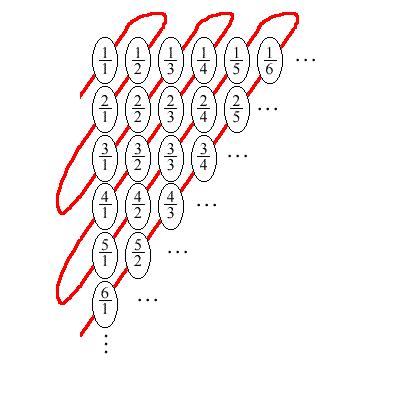
following table:
|
|
|
|
|
| ... |
|
|
|
|
| ... | |
|
|
|
| ... | | |
|
|
| ... | | | |
|
| ... | | | | |
| ... | | | | | |
| · | | | | | | |
| · | | | | | | |
| · | | | | | | |
How can infinity-squared possibly be countable, and therefore the
same as infinity?
The first thing to do is to take a deep breath and remember that
infinity is not a number. In fact, the rationals are
countable. To prove this, consider the above table.
Is the table a list of all the positive rationals? Consider the general term for a positive rational, p/q, where
both p and q are positive. If it's on the table, then we know
we've got all the positive rationals there. (If we hadn't, yet
p/q were on the table, there would be a positive rational that
can't be represented as p/q, which is not the case.) Is it
there?
Yes, it's on the pth row in the qth column.
So, we have a complete list. However, trying to count along each
row or column in turn gives problems - each row and column is
infinitely long, after all, and so we'll never reach the end of
the first to start on the second. Is there, then, a way of
counting them without missing any out?
Yes. Just follow the red line in the image below:
So we know we've counted every rational at least once. Have
we counted them at most once?
Obviously, we haven't. 1/1 = 2/2 = 3/3 = ... means 1 is the first,
fifth and thirteen number in the list.
Why does this matter? It's a good habit to get into, certainly,
but more than that it's useful here to convince ourselves that
these sets of numbers are all the same size. If we don't check
we're not counting the rationals too many times, what's to stop
there being more natural numbers than there are rational
ones?
Intuitively, this seems to be a fairly silly fear (after all, the
natural numbers are just the first column of the entire table of
rationals) but if you're not doubting your intuition by this
stage, I haven't explained what we're doing well enough.
We could just check each number we reach against all the previous
numbers, making sure it's not equal to any of them. That would
work, but ignores the fact that the order in which we're counting
these numbers means the first time we meet each one, it's in its
simplest possible form.
Consider our trusty p/q, in row p, column q. Assume this is
the number in its simplest form - p and q have no common
factors greater than 1. The next time we meet the same number,
it'll be 2p/2q, which is in row 2p, column 2q, therefore on
a diagonal further from our start point. (n+1)p/(n+1)q is always
further along than n p/n q (if you need convincing, find a formula
to tell you which integer is the leftmost point on the diagonal
passing through y/x).
So every time we reach a rational not in its simplest form, ignore
it.
Hence the positive rationals can be put into one-to-one
correspondence with the naturals, and so are countably infinite.
Multiply by -1 and we get a similar list of the negative
rationals. Then, just as we did with the integers, start at 0 and
interleave the two lists:
| Natural numbers | 1, | 2, | 3, | 4, | 5, | 6, | 7, | ... |
| Rationals | 0, | 1/1, | -1/1, | 1/2, | -1/2, | 2/1, | -2/1, | ... |
We know we will have every positive and every negative rational,
and zero, once and only once.
Thus the natural numbers are countable, the integers are countable
and the rationals are countable. It seems as if everything is
countable, and therefore all the infinite sets of numbers you can
care to mention - even ones our intuition tells contain more
objects than there are natural numbers - are the same size.
This is not the case.
Counting the reals: Cantor's Diagonal Proof
Are the real numbers countable? (The real numbers are all the
irrationals - those numbers that cannot be written as one integer
divided by another: p, Ö2, e, ... - and the
rationals together: 1, 4/5, p, ...)
Every other set of numbers we've met so far has been countable.
Each new set of numbers that feels as if it should be
larger than the set of the natural numbers has been put into
one-to-one correspondence with the natural numbers - all we needed
was to work out how to list the numbers sensibly.
The real numbers are made up of the rationals and the irrationals.
The rationals are countable, so if the irrationals are countable
then the reals must be countable - just interleave our two
systematic lists and we'll get another systematic list.
For the same reason, if the reals aren't countable, we'll
know that the problem comes with the irrationals.
You've probably met rational numbers in at least two guises - one
is that they can be written as one integer divided by another, and
the other is that they can be written as decimal expansions that
eventually become repeating patterns.
1/3 = 0. 3 3 3 3 3 3 3 3 3 3 3 3 3 3 3 3 3 3 3 3 ... - the threes
repeat forever.
3/8 = 0. 375 0 0 0 0 0 0 0 0 0 0 0 0 0 0 0 0 0 ... - the zeros
repeat forever.
22/7 = 3. 142857 142857 142857 142857 ... - 142857 repeats
forever.
In fact, all real numbers can be represented as infinitely long
decimal expansions. The rationals are the ones that eventually
repeat and the irrationals are the ones that don't.
p = 3. 14159 26535 89793 23846 ... - at no point does a finitely
long string of digits start repeating for ever.
Now, suppose the real numbers were countable. Then we could write
a systematic list of all the real numbers. What is more, we could
do it as list of decimal expansions.
(In the following list, a(n,m) is the mth digit along in
the nth number down the list.)
a(0,0). a(0,1)a(0,2)a(0,3)a(0,4)a(0,5)...
a(1,0). a(1,1)a(1,2)a(1,3)a(1,4)a(1,5)...
a(2,0). a(2,1)a(2,2)a(2,3)a(2,4)a(2,5)...
a(3,0). a(3,1)a(3,2)a(3,3)a(3,4)a(3,5)...
a(4,0). a(4,1)a(4,2)a(4,3)a(4,4)a(4,5)...
. . .
We might run into trouble with repeating a number without
realising it (0.9 recurring = 1, for instance) but we can just
check every number in our list off those that came before. It
might be that the system we use to list the numbers lends itself
to a neater method, as we found with the rationals, but even if it
doesn't, this method will work.
But can we be certain we haven't missed any out?
One way of answering this question is to assume our list is, in
fact, infinitely long. Then is it possible for it to contain every
possible real number?
The answer is that it isn't. Not all infinities are, we finally
see, the same size. The problem, however - one raised and answered
by Georg Cantor - is how to show this. How can we write down or
describe a number that we know won't be on the list?
Before reading on, take a moment to think about this yourself. It
may help to think back to the title of this section: Cantor's
Diagonal Proof.
***
Consider the number A, where A = a(0,0) . a(1,1)a(2,2)...a(n,n)... (If the list above had started
1.111..., 2.222..., 4.379..., A would start 1.27..., as 1 is the
noughth digit of the noughth number, 2 is the first digit of the
first number, and 7 is the second digit of the second number)
Now, letting m take the value of all the natural numbers (and
zero) in turn, do the following:
If a(m,m) ¹ 5, let b(m,m) = 5.
If a(m,m) = 5, let b(m,m) = 7.
Then we have a new number, B = b(0,0) . b(1,1)b(2,2)...b(n,n)... Is B on our list?
Well, it's not the first number, because the first digits don't
agree (if the first digit of the first number isn't 5, then the
first digit of B is. And if the first digit of the first number
is 5, then the first digit of B isn't). And it's not the
second number, because the second digits don't agree. And it's not
the nth number, because the nth digits don't agree...
So B can't be the first number, and it can't be the second, and
it can't be the nth, for any value of n, so it isn't on our
list.
We could still run into the problem mentioned earlier, that some
numbers with recurring digits are the same number, even when the
digits are different. However, this is a problem that only occurs
when the digits involved are 0's and 9's, and the digits making up
B were specially chosen so this would not happen.
Therefore, we know that B is a unique number. This means the
list isn't complete, and can never be complete. However cunning
our system, even if the list is infinitely long it won't contain
every real number.
This means that we can't count all the real numbers - there are
uncountably infinitely many.
Katherine Körner is
currently a second year undergraduate studying Mathematics at Balliol College,
Oxford