Curt from Reigate College started by
getting a general formula for Triangle numbers
$T_n = 1 + 2 + 3+ . . . +(n-1) + n$
$T_n = n + (n-1) + . . . + 3+2+1$
The second line is just a repeat of the first but with the terms
in reverse order.
Then adding the two lines the right hand side becomes $n$ lots of
$n+1$
So $2T_n=n(n+1)$\par and since everything was added in
twice,
$T_n=\frac{n(n+1)}{2}.
David from Sha Tin College used a known
general result for any progression that steps up by a fixed
amount term on term
$\frac{n}{2}(2a+(n-1)d)$
where n is the number of terms, a is the starting term and d is
that step up.
If the step up is equal to 1, and the start value is also 1, you
can see that this is the same result as Curt demonstrated.
Continuing with the Pentagonal numbers
The diagram shows $P_4=3T_3+4$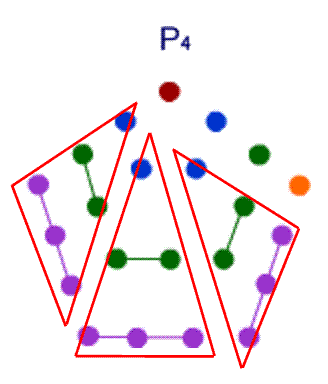
And in general Pn=3Tn-1+n
Now using the result for Tn to see Pn in terms of n
We now have to show that three times that result is a triangle number
and is the same as
or
And that's the same as T3n-1 the required result