This solution was submitted by Curt
from Reigate College. Well done Curt.
(1) Explain the features of the graph of the relation |x|+|y|=1.
If the above equation is true then neither |x| nor |y| can be
greater than 1. If say 1+h = |x| > 1, we have: 1+h + |y| = 1 and so |y| = -h < 0, a contradiction, as |a| ³ 0 for any
a. Therefore, this function is not defined for values of x and
y greater than 1.
I now quote without proof the fact that if |a| = t then a = t or
a = -t. This is useful when applied in this problem.
If |y| = 1- |x| then y = 1 - |x| or y = -1 + |x|. If y = 1- |x| then y = 1 + x or y = 1-x. Similarly, if y = -1 + |x|, then
y=x-1 or y=-x-1.
The graph is the line segments (where -1 < x < 1 and -1 < y < 1) given
by: y=1-x in the first quadrant; y=1+x in the second quadrant;
y=-1-x in the third quadrant and y=x-1 in the fourth quadrant.
Editor's note: By symmetry if (a,b) satisfies this relation
then so does
(b,a), (-a,b) (-b,a) (-a,-b), (-b,-a), (a,-b), and (b,-a)
so the graph is the square consisting of the four line
segments described.
The line segments are perpendicular and intersect at (0,1), (-1,0)
(0,-1) and (1,0). The square shape with vertices at the above
co-ordinates, has symmetry in y=x, y = -x, y=0 and x=0. I
refer to this as a graph, not a function, due to one-to-many
relation.
2) As n/(n+1) can be written as 1/(1+1/n), by dividing both
numerator and denominator by n we consider:
æ ç
è
1+
1n
ö ÷
ø
n
= 1 + n
æ ç
è
1n
ö ÷
ø
+
n(n-1)2
æ ç
è
1n
ö ÷
ø
2
+ ¼
= 2 + ¼ ³ 2 > 1 .
Taking the nth root
1+
1n
³ 21/n > 11/n = 1
Hence
1(1+1/n)
=
n(n+1)
£
121/n
< 1.
(3) Taking the simple case x2 + y2 = 1 (the circle), and
considering the first quadrant, it will be shown that y decreases
as x increases. As this is in the first quadrant, the positive
root alone is considered: y = (1-x2)1/2. As x increases to
a maximum value of 1 on the interval 0 £ x £ 1 so x2
increases monotonically and f(x)=1-x2 decreases monotonically (to
confirm, check f'(x)=-2x).
If we have f(x1) > f(x2) (with x1 < x2), then taking the
positive square root of both sides, we have f(x1)1/2 > f(x2)1/2. So as x increases, y decreases.
This same method could be extended to all values of n. For g(x) = 1-xn then g(x+h) < g(x) for h > 0 because xn increases
monotonically on the interval 0 < x < 1. Clearly, if x1 < x2 then
x1n < x2n so 1-x1n > 1-x2n and hence g(x1) > g(x2).
Taking the positive nth root of both sides, we get: y1 = g(x1)1/n > g(x2)1/n=y2. So y1 > y2 for x1 < x2
; hence as x increases in the first quadrant, y decreases.
Editor's note: Alternatively we can use calculus to prove this.
Fixing one value of n in xn+yn=1:
yn
= 1-xn
nyn-1
dydx
= -nxn-1
dydx
= -
xn-1yn-1
< 0.
As x and y are positive in the
first quadrant we see that the derivative is negative which shows
that y decreases as x increases.
When x=y, on the general graph xn + yn = 1 we get 2xn=1 so
x=y=1/(21/n). From earlier in this question, we have for n > 1,
nn+1
<
121/n
so x=y > n/(n+1).
Therefore, as there is
only one solution to 2xn = 1 in the first quadrant, the graph
should lie outside the square with coordinates:
In the first quadrant, as x,y ³ 0, and on xn + yn = 1,
neither x nor y may be greater than 1, there are no co-ordinates
on the curve for which x,y > 1. If x > 1 then xn=1+g, for g > 0
so yn=-g, which is not allowed in the first quadrant. The curve
must lie inside (or on at the co-ordinate axes) the square with
coordinates (1,0), (0,1), (1,1), (0,0) NB, the curve will touch the
square only at vertices (1,0) and (0,1).
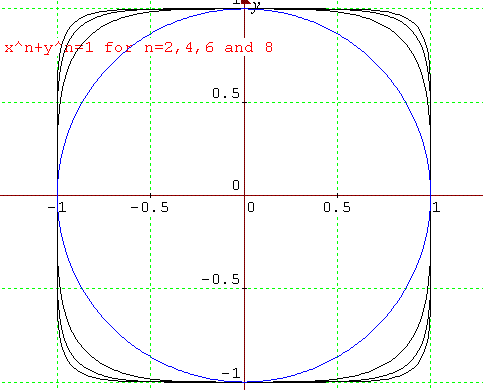
(4) As n ® ¥, 1/(1+1/n) = n/(1+n) ® 1.
The square which the curve must lie within is fixed (as above).
However, as n increases, the square which the curve must lie
outside of gets increasingly large. As the curve is squeezed
between two squares, its shape becomes increasingly more squared.
For curves where n is even, the curve becomes squeezed in all four
quadrants because, by symmetry (exactly as in part (1) of this
question) the graph is symmetric about y=x, y=-x, y=0 and
about x=0.
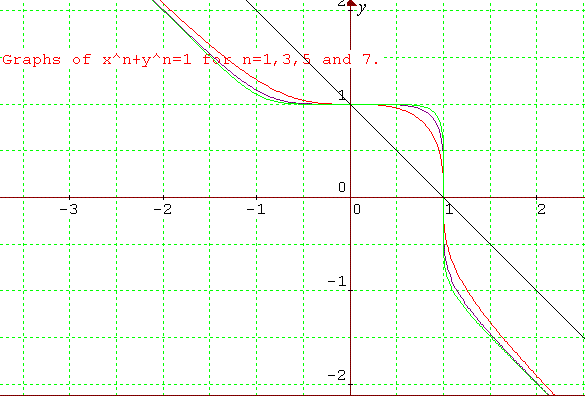
(5) In the first quadrant the graph of the relation x3 + y3 = 1
behaves similarly to other graphs where n is even. However, the
graph cannot be defined in the third quadrant for x < 0 and y < 0,
for that would lead to the sum of two negative numbers being 1,
which is not possible. The function is also defined for x > 1, for
negative numbers do have real cube roots. If x3 = 1+a then y3 = -a and so y=-a1/3 and x = (1+a)1/3. For large x (large
a) this shows that x » -y, therefore the graph reaches an
asymptote with y = -x. The same thing happens as x ® -¥ in
the second quadrant.
The same features occur for the whole family of graphs of xn + yn=1 for odd n.
The graphs of |xn| + |yn| = 1 for odd n would have the
symmetrical squarish shape, reflecting the family of graphs in the
first quadrant into the remaining quadrants (see part 1).
+abs(x)=1.gif)