1) To satisfy the relation |x|+|y|=1 both x and y must be between
-1 and 1.
If (a,b) satisfies this relation then so does
(b,a), (-a,b) (-b,a) (-a,-b), (-b,-a), (a,-b), and (b,-a).
Hence this graph is the square joining the points (1,0), (0,1), (-1,0), (0,-1) and
(1,0) in this order.
Alternatively the graph is the line segments (where -1 < x < 1 and
-1 < y < 1) given by: x+y=1 in the first quadrant; -x+y=1 in the
second quadrant; -x-y=1 in the third quadrant and x-y=1 in the
fourth quadrant.
(2) As 21/n must be greater than 1 we take 21/n=1+d
where d > 0. Expanding by the Binomial Theorem, because all
the terms are positive, we have:
2=(1+d)n > 1+nd.
Hence 1 > nd and so d < 1/n. It follows that
1 < 21/n < 1 +
1n
=
n+1n
and so
nn+1
<
121/n
< 1.
(3) Fixing one value of n in xn+yn=1:
yn
= 1-xn
nyn-1
dydx
= -nxn-1
dydx
= -
xn-1yn-1
< 0.
As x and y are positive
in the first quadrant we see that the derivative is negative which
shows that y decreases as x increases.
The relation is symmetric in x and y so the graph is symmetric
about the line y=x and goes through the point
(
121/n
,
121/n
)
. In part (2) we showed that
121/n
is
sandwiched between
nn+1
and 1. So the graph is confined
between the two squares described.
(4) By a symmetry argument exactly as in part (1) the graph of
|x|n+|y|n=1 is symmetrical about the lines y=x, y=-x, x=0, y=0.
Because
nn+1
® 1
as n® ¥ we see that, as n
increases, the graphs in this family are confined to a narrower
and narrower band rapidly becoming almost square in shape.
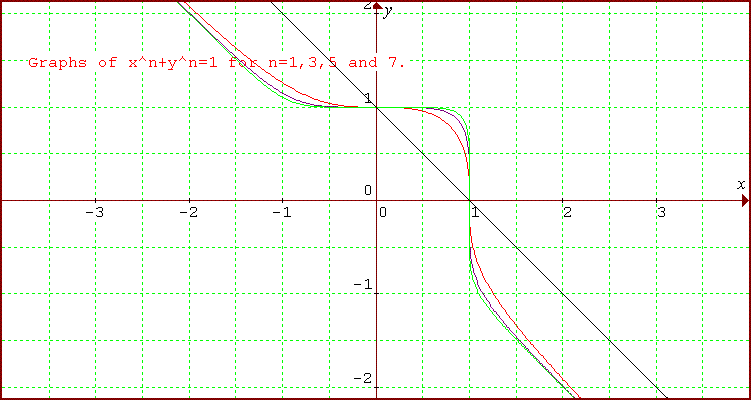
(5) For odd values of n there are no points satisfying the
relation xn+yn=1 in the third quadrant where x and y, and
all odd powers of these variables, are negative.
In the second quadrant if x is large and negative then xn is
large and negative and yn=1-xn is large and positive and y® -x as n® ¥.
By a similar argument, or explaining it by the symmetry of the
relation, y® -x as n® ¥ in the fourth quadrant.
+abs(x)=1.GIF)