Congratulations to Andrei from Tudor Vianu National College, Bucharest,
Romania for this
excellent solution. (1) Plot the graph of the function
where
. Differentiate the function and say where
the derivative is defined and where it is not defined.
I observe that
takes positive values between
and
(for integer
), that is in the first two quadrants,
and
takes negative values between
and
, that is in the third and fourth quadrants. So
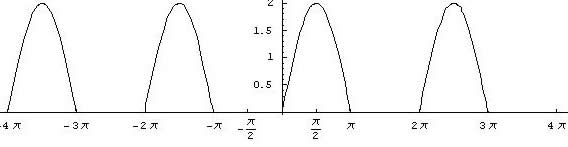
Below is
represented the graph of y = f(x):
Now I calculate the first derivative of
:
The derivative
is not defined at the points
for any integer
and it does not have a tangent at these points.
(2) Now I express the function
in the form
, find
and
and plot the graph of
this function. Similarly I express the function
in the form
where
, and plot its graph on the same axes.
As this formula must be valid
for any x, I obtain:
and hence
,
and
.
Comment: If
has the meaning of an amplitude,
is positive,
and only the positive solution must be kept. This type of problem is
typical for the composition of oscillations.
Hence the graph of this function is a sine graph with a phase shift
of
, that is
when
, it takes the
value 1 when
and
and the value -1 when
and
, has maximum values
and minimum values
In a similar manner I write
:
So I have
and hence
,
and
. Hence
the graph of this function is a sine graph with a phase shift of
, that is
when
, it takes the value
1 when
and
, has maximum values
and minimum values
.
(3)
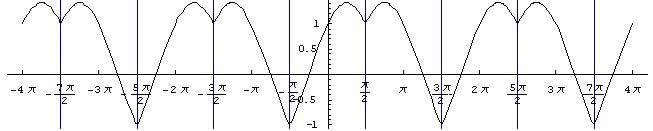
Now, I calculate the function
and plot the graph.
The derivative is not defined at
and
for other values of
it is: