(1) The
function can be defined separately where sinx takes positive
values between 2kp and (2k+1)p (for integer k), that is
in the first two quadrants, and where sinx takes negative
values between (2k+1)p and (2k+2)p, that is in the third
and fourth quadrants.
f(x)
= 2sinx for 2kp £ x £ (2k+1)p
= 0 for (2k+1)p £ x £ (2k+2)p.
The
first derivative:
f¢(x)
= 2cosx for 2kp < x < (2k+1)p
= 0 for (2k+1)p < x < (2k+2)p
and the derivative
f¢(x) is not defined at the points x = kp for any integer
k.
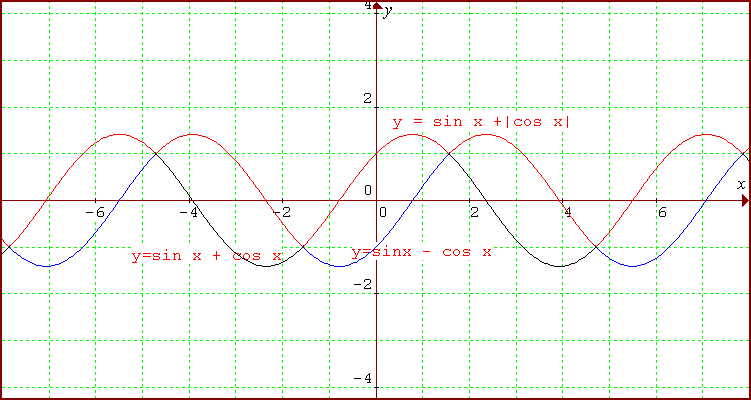
(2)
f(x)
= sinx + cosx = Asin(x + a)
= Asin xcosa+ Acosx sina
implies that
Asina = 1 and Acosa = 1
and hence tana = 1, a = p/4 and A=Ö2.
Hence the graph of this function is a sine graph with a phase
shift of p/4, that is f(x)=0 when x=kp- p/4, it takes
the value 1 when x=2kp and x=2kp+ p/2 and the value -1
when x=(2k+1)p and x=2kp- p/2 , has maximum values
(2kp+p/4, Ö2) and minimum values ((2k+1)p+ p/4, -Ö2)
f(x)
= sinx - cosx = Bsin(x + b)
= Bsin xcosb+ Bcosx sinb
implies that
Bsinb = -1 and Bcosb = 1
and hence tanb = -1, b = -p/4 and B=Ö2.
Hence the graph of this function is a sine graph with a phase
shift of -p/4, that is f(x)=0 when x=kp+ p/4, it
takes the value 1 when x=kp and x=2kp+ p/2, has maximum
values (2k+1)p- p/4, Ö2) and minimum values (2kp- p/4, -Ö2)
f(x)
=sinx + |cosx|
= sinx + cosx for 2kp-p/2 £ x £ 2kp+p/2
= sinx - cosx for 2kp+ p/2 £ x £ 2kp+ 3p/2 .
The
derivative is not defined at x = kp+ p/2 and for other
values of x it is:
.GIF)
.GIF)