This solution was written by Andrei from Tudor Vianu National College,
Bucharest, Romania.
I calculate the values of
for
and
:
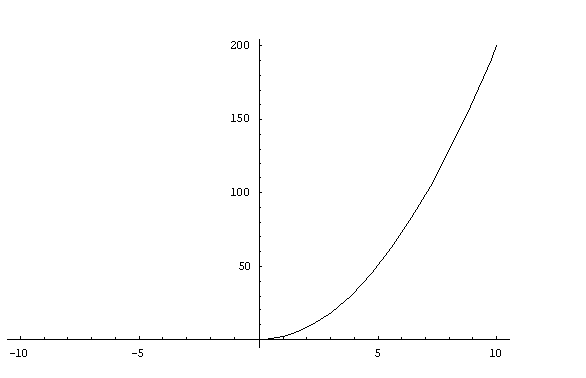
Its graph is represented below:
Now, I find the first derivative of f(x):
I observe that for
,
is 0 both from the first and
from the second form of f(x), that is on both sides of the origin.
So the first derivative
exists at
. Hence the graph
of f(x) has the tangent at
at the origin
Now, I calculate the second derivative:
Hence the second derivative does not exist at the origin because on
the left the limiting value of
as
is 0 whereas on
the right the limiting value of
as
is 4. So there
isn't a unique tangent to the graph of
at
.