Thank you to Shaun from Nottingham High School and Andrei from
Tudor Vianu National College, Bucharest, Romania for these
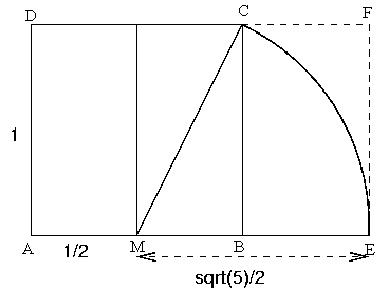
solutions. (1) Drawing the figure, I observe that ratios
and
are approximately equal, having a value of 1.6.
(2) From Pythagoras' Theorem I calculate
(in the right-angled
triangle
):
So
and
.
The ratios are:
and
So,
(3) From this equality of ratios, I find out that
But
so
(4) Substituting
the left hand side of this expression is
less than the right hand side. If we increase the value given to
the left hand side increases and the right hand side
decreases continuously. Substituting
the left hand side
is greater than the right hand side so the value of
which
satisfies this equation must lie between
and
.
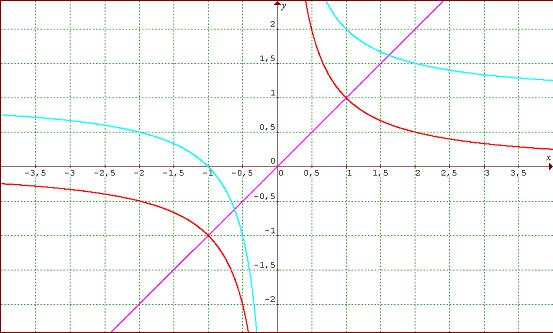
The two solutions of the equation can be found at the intersection
of the cyan curve (
) and magenta curve (
. Only the
positive value is considered and it is approximately 1.618.
(5) Now, I solve the equation. It is equivalent to
so the solutions are