Thank you to Shaun from Nottingham High School and Andrei from
Tudor Vianu National College, Bucharest, Romania for these
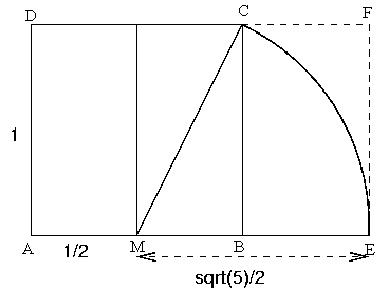
solutions. (1) Drawing the figure, I observe that ratios AE/AD and BC/BE
are approximately equal, having a value of 1.6.
(2) From Pythagoras' Theorem I calculate MC (in the right-angled
triangle MBC):
MC2
= BC2 + MB2 = 1 + 1/4
MC
= Ö5 /2
.
So AE=(Ö5 + 1)/2 and BE=(Ö5 - 1)/2.
The ratios are:
AEAD
=
Ö5 + 12
and
BCBE
=
1(Ö5 - 1)/2
=
Ö5 + 12
.
So, AE/AD = BC/BE.
(3) From this equality of ratios, I find out that
BE =
AD.BCAE
=
1f
But AE = AB + BE so
f = 1 +
1f
.
(4) Substituting f = 1 the left hand side of this expression is
less than the right hand side. If we increase the value given to
f the left hand side increases and the right hand side
decreases continuously. Substituting f = 2 the left hand side
is greater than the right hand side so the value of f which
satisfies this equation must lie between 1 and 2.
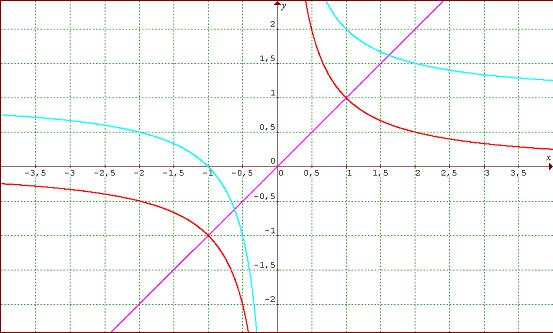
The two solutions of the equation can be found at the intersection
of the cyan curve (y=1 + 1/x) and magenta curve (y=x). Only the
positive value is considered and it is approximately 1.618.
(5) Now, I solve the equation. It is equivalent to f2 - f-1 = 0 so the solutions are