Thanks Jack from Pate's School, Yosef from Yeshivat Rambam High
School, Baltimore, Andrei from Tudor Vianu National College,
Bucharest, Romania and Curt from Reigate College for your solutions.
The binary operation
for combining sets is defined as
.
To prove that
, consisting of the set of all subsets of a set
(including the empty set and the set
itself), together with the
binary operation
, forms a group (assuming that the associative
property is satisfied) it has to be shown that
is closed, it
contains an identity element and for each element in
there is an
inverse element contained in
.
If
and
are two subsets of the set
, then
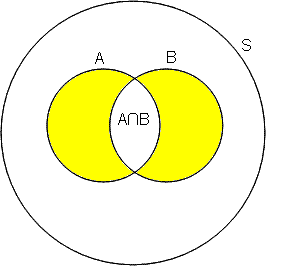
is also a set, and
is the
subset of
shown in colour in Andrei's diagram. Hence the closure
property is satisfied.
The union of any set
and the empty set
, is
, and there
is no intersection between
and
as
contains no
elements to intersect.
Therefore
is the identity
element.
The intersection of a set with itself is itself,
and the union of a set with itself is itself, for any set
, that is
Therefore
the inverse of any element is itself, each element of
is self
inverse.
The fourth property, associativity, was assumed so we have shown
is a group.
To solve
, rewrite it as
, where the
solution is
. We consider the set of all subsets of the
natural numbers and note that this is an example of the group
discussed above. Hence as the element
is self inverse: