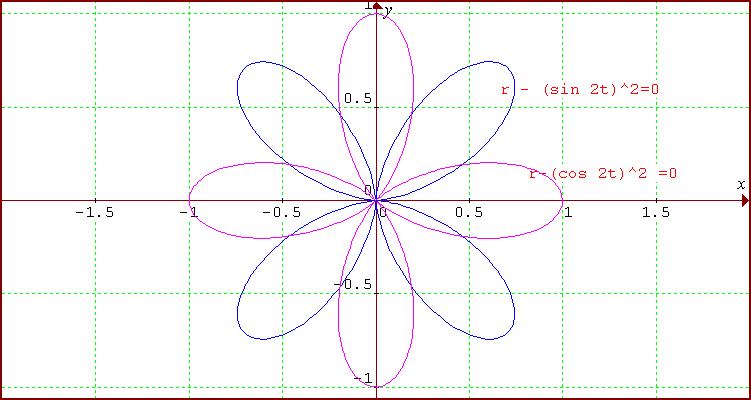
Solving the quadratic equation $$ r^2 - r + {\textstyle{1\over
4}} \sin^2 4\theta = 0$$ we get $$\eqalign{ r &= {-1 \pm
\sqrt {1-\sin^2 4\theta}\over 2}\cr &= {1\pm \cos 4\theta
\over 2} \cr &= \sin^2 2\theta,\quad \cos^2 2\theta .}$$
Hence the expression factorises to give $$( r- \sin^2
2\theta)(r-\cos^2 2\theta)= 0.$$
Consider first the graph of
. For points on
this graph, as
increases from 0 to
we
have
increases from 0 to 1. Between
and
the value of
decreases from
1 to 0 so that the graph in the first quadrant is a 'petal'
symmetrical about the line
.
Similarly the graph in the second quadrant is a 'petal' for
between
and
where
takes
positive values corresponding to
. The graph in the
third quadrant is a 'petal' for
between
and
and the graph in the fourth quadrant is a 'petal'
for
between
and
.
Next consider first the graph of
. This will
be of the same form but rotated by
corresponding
to the phase shift between the graphs of
and
.
For points on this graph, as
increases from 0 to
we have
decreases from 1 to 0. Between
and
the value of
increases from 0 to 1 and between
and
, as
decreases from 1 to 0, the 'petal' symmetrical about
the y-axis is completed.
The next petal, symmetrical about the negative x-axis, is drawn
for
between
and
. The
next petal, symmetrical about the negative y-axis, is drawn for
between
and
and the
remaining petal is completed for
between
and
.