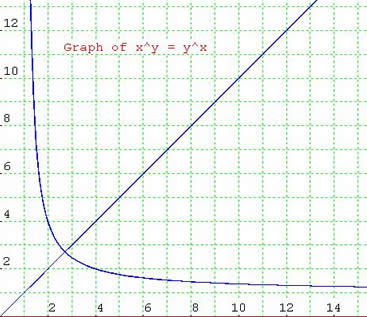
All points on the line
except the point
lie on the
graph but the function is not defined at the origin.
From the equation we see that the graph is symmetrical about the
line
because interchanging
and
in the equation
produces the same equation so that if
satisfies the
equation then
also satisfies the equation.
For
each line
for
cuts the graph of
in two points
and
such
that
or, equivalently,
. Hence the two
points
and
are on the graph of
. For
example
so
and
are on the graph of
.
The maximum point of the graph of
is the point
so the point
lies on the graph of
.