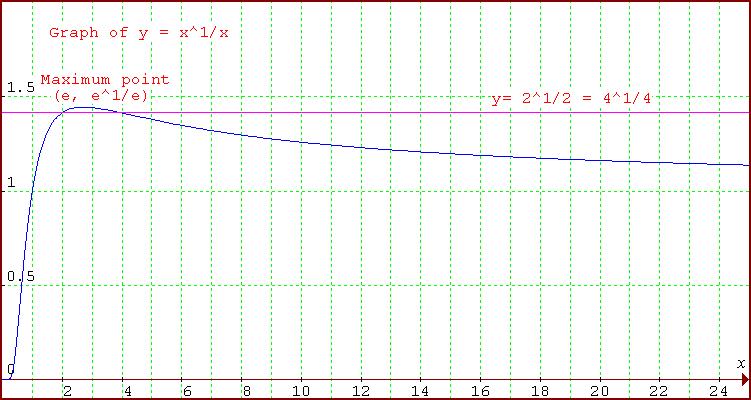
Well done Curt from Reigate College for this solution. If
, by the chain rule:
As
is never zero, the gradient function of
is zero when
the gradient function of
is zero and it always has the same
sign as
so
and
have the same turning points.
To answer the question of turning points of
let's first find the derivative of
.
The derivative is positive for
, that is
, it is is
zero when
,
and it is negative for
. Hence
the function is increasing for
and decreasing for
.
At
the second derivative of
is
which is
negative so
has a maximum and so
has a maximum.
Therefore
is a maximum point of
.
To prove
as
we may use the similar result for the discrete case
.
As the graph of
is decreasing as
for each value of
there is a value of
for which
and vice versa so both tend to the same limit
which is 1.
What if
? Well, as suggested in the question,
letting
in
, one can note that as
,
. Writing
,
As
we have
and
so
.
Hence the graph of
is always above the line
although the function is undefined at
.