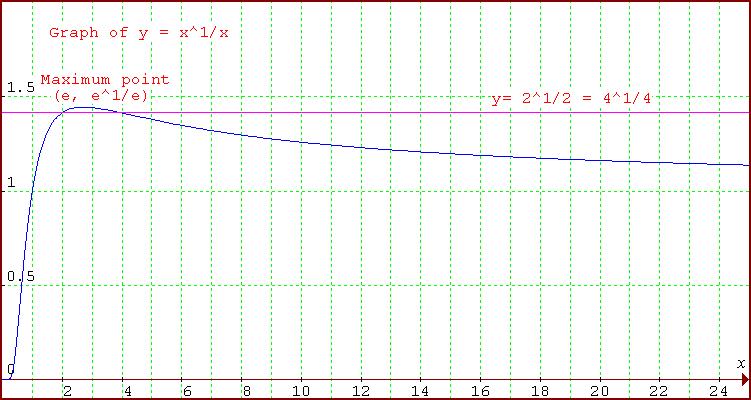
Well done Curt from Reigate College for this solution. If
G(x)=ef(x), by the chain rule:
G¢(x)=ef(x)*f¢(x).
As e is never zero, the gradient function of G(x) is zero when
the gradient function of f(x) is zero and it always has the same
sign as f¢(x) so G(x) and f(x) have the same turning points.
To answer the question of turning points of G(x)=x1/x = e1/xlogx let's first find the derivative of 1/xlog x.
ddx
f(x)=
ddx
(
1x
logx) =
1-logxx2
.
The derivative is positive for logx < 1, that is x < e, it is is
zero when logx = 1, x = e and it is negative for x > e. Hence
the function is increasing for x < e and decreasing for x > e.
d2dx2
(
1x
logx) =
-x-2x(1-logx)x4
=
2logx -3x3
.
At x=e the second derivative of f(x) is -1/e3 which is
negative so f(x) has a maximum and so G(x) has a maximum.
Therefore (e, e1/e) is a maximum point of G(x)=x1/x.
To prove
lim
x1/x ® 1
as x® ¥
we may use the similar result for the discrete case n1/n.
As the graph of f(x)=x1/x is decreasing as x® ¥
for each value of x there is a value of n for which
n1/n < x1/x and vice versa so both tend to the same limit
which is 1.
What if x® 0? Well, as suggested in the question,
letting 1/x=t in x1/x, one can note that as
x® 0, t® ¥. Writing t=1/x,
x1/x =
æ ç
è
1t
ö ÷
ø
t
=
1tt
.
As x® 0 we have t® ¥ and tt ® ¥ so
x1/x =
1tt
® 0
.
Hence the graph of y=x1/x is always above the line y=0
although the function is undefined at x=0.