and, as e is never zero, the turning points of ef(x) occur
for the same values of x as the turning points of f(x).
Now x1/x = e1/xlogx and
ddx
(
1x
logx) =
1-logxx2
.
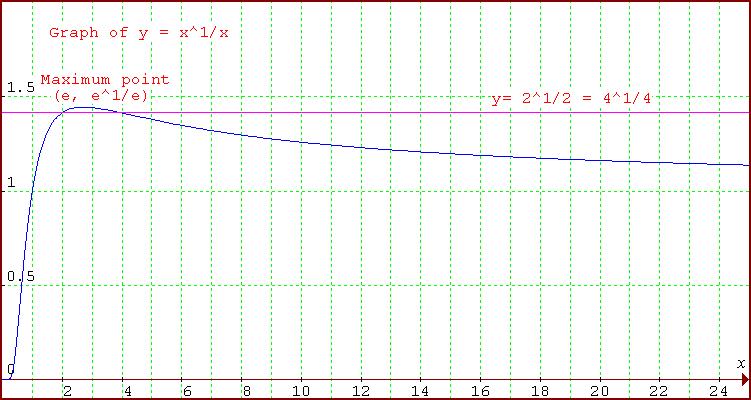
The derivative is positive for logx < 1, that is x < e, it is
is zero when logx = 1, x = e and it is negative for x > e.
Hence the function is increasing for x < e and decreasing for
x > e.
d2dx2
(
1x
logx) =
-x-2x(1-logx)x4
=
2logx -3x3
.
At e this is -1/e3 so (e, e1/e) is a maximum point.
As the graph is decreasing as x® ¥ for each value of x
there is a value of n for which n1/n < x1/x and vice versa
so both tend to the same limit which is 1.
Writing t=1/x,
x1/x =
æ ç
è
1t
ö ÷
ø
t
=
1tt
.
As x® 0 we have t® ¥ and tt ® ¥ so
x1/x =
1tt
® 0
.
Hence the graph of y=x1/x is always above the line y=0
although the function is undefined at x=0.