Congratulations to Curt, Reigate College and to
Andrei, Tudor Vianu National College, Bucharest, Romania
for you solutions to this problem
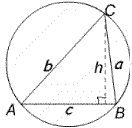
When AB is a diameter angle
is 90 degrees so we can use Pythagoras' Theorem. The
area of the triangle is given by
where
is the length of the
perpendicular from
to
. Then
Thus
is a maximum
when
is a maximum and equal to the radius of the circle
. So the maximum value of
is
.
When
is not a diameter we have (using the Cosine Rule):
As the area of triangle ACB is given by
we have
If we keep
and
fixed and vary
then, as
and
are constant, and the area of the triangle
is a
maximum when
is a maximum, it follows that
is a
maximum when
is a maximum, that is when
and the altitude
of the triangle drawn from
to
is a line of symmetry of
the triangle. In this case
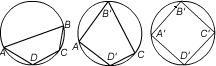
Conjecture: Let
be a variable cyclic quadrilateral in a circle
of radius
. Then the area and the perimeter of
will be a
maximum when
is a square; that is when each of the diagonals
of the quadrilateral is a diameter and each diagonal bisects
of the other diagonal at right angles.
Labelling
as
, consider triangle ABC with AC fixed and B
varying. Let
be the position of
when, by the previous
result
is a maximum, that is when
Note that
this also gives the maximum area of triangle
. Similarly by
considering triangle
with
fixed, we find
where
is a maximum and
. Now
is a diameter, keep
this fixed and consider triangles
and
. The
positions of
and
that maximise the perimeter and area are
and
where
is a diameter. Hence, for the perimeter
and area of
to be a maximum all the sides of the quadrilateral
must be equal making
a square. Hence the maximum perimeter is
and the maximum area is
.