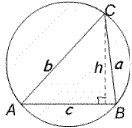
Angle ACB is 90
degrees so we can use Pythagoras Theorem. The area of the triangle
is given by 1/2ab = 1/2ch
where h is the length of the perpendicular from C to AB.
Then
(a+b)2=a2+b2+2ab=c2+2ch.
Thus (a+b)2 is a maximum
when h is a maximum and equal to the radius 1/2c of the circle . So the maximum value of a+b is cÖ2
When AB is not a diameter we have:
(a+b)2
= a2 +b2 + 2ab
= c2 + 2abcosÐACB +2ab
= c2 +2ab(1+cosÐACB)
=c2 +4ab cos21/2ÐACB.
As the area of triangle ACB is given by
D = 1/2absinÐACB we have
(a+b)2
= c2 + [(8Dcos21/2ÐACB)/(sinÐACB)]
= c2 + 4Dcot 1/2ÐACB
.
If we keep A and B fixed and vary C then, as c and ÐACB are constant, and the area of the triangle D is a
maximum when h is a maximum, it follows that a + b is a
maximum when h is a maximum, that is when a=b and the altitude
of the triangle drawn from C to AB is a line of symmetry of
the triangle. We know the radius of the circle is c/2sinÐACB (Sine Rule) and it is simple to show that, in this case,
a+b=[c(sin 1/2ÐACB)].
Conjecture: Let Q be a variable cyclic quadrilateral in a circle
of radius r. Then the area and the perimeter of Q will be a
maximum when Q is a square; that is when each of the diagonals
of the quadrilateral is a diameter and each diagonal is the
orthogonal bisector of the other diagonal.
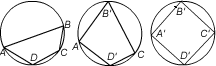
Labeling Q as ABCD, consider triangle ABC with AC fixed and B
varying. Let B ' be the position of B when, by the previous
result AB + BC is a maximum, that is when AB = BC Note that
this also gives the maximum area of triangle ABC. Similarly by
considering triangle ADC with AC fixed, we find D ' where
AD+DC is a maximum and AD=DC. Now B ' D ' is a diameter, keep
this fixed and consider triangles B ' CD ' and B ' AD ' . The
positions of C and A that maximise the perimeter and area are
C ' and A ' where A ' C ' is a diameter. Hence, for the perimeter
and area of Q to be a maximum all the sides of the quadrilateral
must be equal making Q a square. Hence the maximum perimeter is
4rÖ2 and the maximum area is 2r2.