Well done to Nithiya and JY who have sent
in the solution of 843 cubic centimetres, which is very nearly
correct. Alex sent in his work on this problem, which shows how
he gets the right answer.
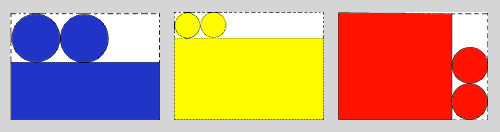
I thought of four ways to arrange things.
In the blue diagram, the size could be chosen in two ways.
If the length of the paper fixes the circumference of the cylinder (so the
height is across the page), then we know that 2pr=29.6, so
r=14.8/p. Also, 2r+h=21 (looking at the width), so
h=21-(29.6/p). So the volume is
|
pr2 h=p× |
14.82
p2
|
× |
æ
ç
è
|
21- |
29.6
p
|
ö
÷
ø
|
» 807 cm3 |
|
(to the nearest whole number).
If the length of the paper fixes the height of the cylinder (think of the
label as being the other way round on the page), then we know that
h=29.6, so 2r+2pr=21, so r=10.5/(1+p). So the volume is
|
pr2 h=p× |
æ
ç
è
|
10.5
1+p
|
ö
÷
ø
|
2
|
×29.6 » 598 cm3 |
|
(to the nearest whole number).
Also, in the red diagram the size could be chosen in two ways.
If the width of the paper fixes the circumference of the cylinder,
then 2pr=21, so r=10.5/p. Also, 2r+h=29.6, so h=29.6-(21/p).
So the volume is
|
pr2 h=p× |
10.52
p2
|
× |
æ
ç
è
|
29.6- |
21
p
|
ö
÷
ø
|
» 804 cm3 |
|
(to the nearest whole number).
Finally, if the width of the paper fixes the height of the cylinder,
then h=21 and 2r+2pr=29.6 so r=14.8/(1+p). So the volume is
|
pr2 h=p× |
æ
ç
è
|
14.8
1+p
|
ö
÷
ø
|
2
|
×21 » 842 cm3 |
|
(to the nearest whole number). This last option is clearly the best.