Here is an operation table for the operation **.
| ** | 0 | 1 | 2 | 3 |
|
|
| 0 | 0 | 0 | 0 | 0 |
| 1 | 0 | 1 | 2 | 3 |
| 2 | 0 | 2 | 1 | 0 |
| 3 | 0 | 3 | 0 | 0 |
Here are some examples of what the table tells us:
We say that this set is "closed" for the operation **because the answer
to any calculation involving two numbers in the set and ** is still in the set.
This means I can keep using and always get an answer in the set.
This operation is also symmetric and it has an identity element of 1
(an identity element does not change the other elements of the set when
it operates on them)
We now have a closed set with an operation that is
symmetric and we have an identity element.
Make up an operation table for addition modulo 4.
Think of this as adding numbers around a clock with only the times
0,1,2 and 3 o'clock - when you add 3 to 3 you get the answer 2
because you move around the clock three "hours" from 3 - landing on 2
(the remainder when you divide 6 by 4).
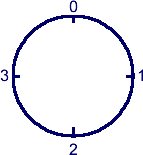
Does it have the same properties as the operation ** above?
Can you identify an identity element? Is it symmetric?
For more information on modulo arithmetic - look in the thesaurus.
What about subtraction and division mod 3 ?
Are addition modulo 3 and multiplication modulo 3 on this set associative?
Are they distributive over each other?
The terms associative and distributive are explained in the thesaurus.