It is often too easy to dive into algebra or
trigonometry to solve problems when other routes to solutions are
available, especially when the question says "find" rather than
"calculate". The two solutions below, one from Richard and one from
Andrei take different approaches. We also solved this using dynamic
geometry software.
Peter of Richard Hale School, approached the
problem using trial and improvement. Here is his solution:
My method of trial and improvement for this problem was to pick an angle
to the horizontal, consider a ladder placed at that angle and make it touch
the ground, the wall and the corner of the storage box. I then calculated
the length of that ladder. I then altered the angle until the length of
the ladder was 3 metres. I then used the angle to calculate the height at
which the ladder touched the wall.
This can be done by applying sin and, cos in the two right-angled
triangles formed between the box, the ladder, the ground and the wall.
Once I knew the angle at which the ladder would be 3m long, I could apply
sin in the large right-angled triangle to find the height against the wall.
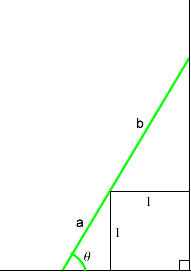
In the lower triangle, if we specify an angle to the horizontal
On the other hand Andrei of Tudor Vianu
College took an algebraic approach. Andrei ended with a quartic and
offers three solutions. There is quite a jump from the ratio
formula to the three solutions but the first part is very
useful.
I see first that in the absence of the square obstacle (in the section) the
ladder could be moved continuously, and, as a limit, it could attain the
height of 3 m, equal to its length.
With the obstacle, it could not touch 3 m height, but in any case, it must
not cross the vertex of the square. A possible procedure to put the ladder
against the wall is to put is vertically, near the corner of the obstacle,
and to rotate it around this corner up to the moment it touches simultaneously
the ground and the wall.
The maximum height is obtained in the situation it touches these 3 points.
This way, the problem reduces to finding the maximum of a leg of a right-
angled triangle, of hypotenuses 3 m, which contains a square of side 1 m.
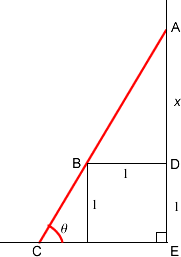
I see first that in the absence of the square obstacle, the ladder could be
moved continuously, and, as a limit, it could attain the height of 3 m, equal
to its length.
With the obstacle, it could not touch 3 m height, but in any case, it must not
cross the vertex of the square. A possible procedure to put the ladder against
the wall is to put it vertically, near the corner of the obstacle, and to rotate
it around this corner up to the moment it touches simultaneously the ground and the wall.
The maximum height is obtained in the situation it touches these 3 points.
This way, the problem reduces to finding the maximum of a leg of a right
angled triangle, of hypotenuses 3 m, which contains a square of side 1 m.
This way the similarity ratio of the upper triangle and the whole triangle is:
Which gives:
This could be treated as an equation in x. Evidently, x must be positive (
being a length) and smaller than 2 (the leg of any right angled triangle
must be smaller than the hypotenuses), i.e.
x + 1 < 3.
The equation above has three solutions for x:
and solution no. 3 is not a solution for the geometry problem.
Now, from the first two solutions, the second is to be chosen, being greater,
and the height corresponding to it is x + 1 = 2.49 m, this being the maximum height.
It seems surprisingly that there are only two solutions where the ladder touches
the obstacle, the ground and the wall.