The first part was well explained by
Shaun from Nottingham High School as follows:
It is not possible to construct a square of 3 sq. units on a 2-D grid using
only integers, because according to Pythagoras the side length must be constructed from the square root of
the sum of the squares of two integers.
If the side of the square was tilted and went
along and
up we would need to find
and
so that
Yet there are no perfect squares which add up to three, hence this is not
possible.
Progressing from here to look for a
square with an area of 3 in a 3D grid could be tackled using
some higher level mathematics involving an operation with
vectors called the scalar product (also called the dot product)
however it is quite possible to produce a very direct solution
using nothing more difficult than Pythagoras and some clear
geometric reasoning.
For those of you who wish to explore the vector method, scroll
down a bit and you will find a nicely explained solution.
But getting back to the Pythagoras solution . . .
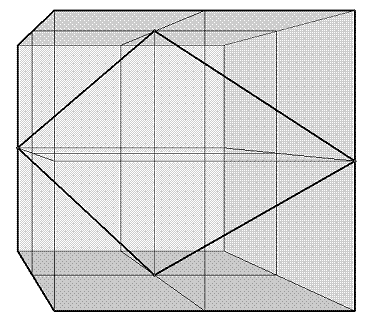
I needed a diagram to help me follow
the reasoning so here is a copy of the drawing I made:
The only way to get a side length of
between vertices with whole number coordinates is to go directly across each unit cube. The path must close in four lengths so there are six choices of direction at the end of the first length (side). Six, because there are eight cubes around the end point of the first length but one is the route we came along already and one is a continuation in the same direction and that will not lead to a closed path of only four lengths.
Whichever of the six choices we take the quadrilateral closed path will have the same shape in each case. The quadrilateral I need to examine has four equal sides and so could be a square, but it could also be a rhombus. It was the diagonals that let me know for sure.
The diagonal length from the start position to the third vertex is
units, but the diagonal length from the second to the fourth position is
Because the diagonal lengths are not equal the quadrilateral is after all only a rhombus I think that exhausts all the possibilities so no solution exists, and there can be no square of side
whose vertices are all integer values.
A vector approach by Andrei from Tudor Vianu College.
For the second part of the question (3D), a first side of the square is defined by the vector
where
,
and
are the unit vectors of the axes
,
and
respectively.
A second side of the square is represented by the vector
where
Vector
must have a modulus of
and form a scalar product with vector
of zero (the condition for the two directions to be perpendicular)
So the two equations that must be satisfied are :
and
There are no integer values for
,
, and
that satisfy both equations. So no square with an area of
units can exist on a 3D integer grid.