Their philosophy is that pupils can achieve higher order
mathematical thinking if they are focused by the teacher's
appropriate use of questions and prompts. They suggest that
questions to promote these six areas of mathematical thinking
could be asked in relation to all the mathematical statements
in the first table. Looking at Table 2 above, we can see that
the modes of thinking most closely related to logic and
reasoning are contained in the last column. Mason and Watson
give many examples of the sort of question a teacher could use
to develop these particular thinking processes. In the general
examples below, each question relates to a different statement
in Table 1:
- Is there anything else which is not an X which is described by this?
- Why is ... an example of ...?
- How can we be sure that ...?
I cannot possibly go into all the detail of Mason and Watson's
research here, but suffice to say it is a fantastic book which
is of immense practical help in the classroom. They propose
three different ways of using the questions to stimulate
mathematical thinking:
- Take a topic and use some specific questions within certain statements and certain groups of mathematical thinking.
- Take a mathematical process from Table 2 e.g. "explaining" and try to find similar examples in different topics to help you make links between topics.
- Take a certain mathematical statement from Table 1 and look for similar questions in different topics, again helping you to make connections but also to understand how that statement differs within topics.
The book refers to several examples of the above to help you
get a feel for what you may be aiming for.
Of course logic is needed in many mathematical problems and the whole of NRICH Prime this month contains such puzzles. There are also several famous conundrums of this type which you may like to tackle with your class. Here are a select few:
The Tower of Hanoi
A legend states that there was once a monastery in Hanoi that had 3 needles. One held 64 different sized discs which were arranged in order of size, with the largest at the bottom. God ordered the monks to move all the discs to another needle so that they ended up in the same order. To do this they were allowed to use all the needles but a larger disc could not be put on top of a smaller one. The legend had it that when they moved the last disc the world would end.
How would this be done? Here is a simpler version which has
just 3 discs:
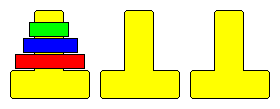
Try to move all three discs from this starting position obeying the rules above.
For an interactive version of this puzzle, visit
www.cut-the-knot.com/recurrence/hanoi.shtml
The Journey across the Stream
A fox, a hen and a bag of grain need to get to the other side of a stream. The fox and the hen can't swim. A man with a boat can take them but the boat can only hold two things as well as him. However, the fox will eat the hen if they are left on the bank together, or if they travel in the boat at the same time. Similarly, the hen will eat the grain if she is left with it or if it travels with her in the boat. How can the man carry all three safely to the other side of the stream?
Mazes
Logical thinking can help find the quickest way through mazes, which have fascinated people for centuries. This article contains more information and there are many maze problems in the archive. Try July 01 and Sep 01.
And if that's not enough
The following website has a whole page that is devoted to maths logic puzzles.
Go to www.fi.edu/sin/school/tfi/spring96/puzzles/index.html .
Don't forget Lewis Carroll's stories of Alice and his wonderful use of logic. Read this month's sister article for more details.
We hope to have given you some guidance and inspiration on the development of logical thinking in your classroom. This time of year would be perfect for trying out the above activities and practising your questioning techniques. Good luck.
References
Watson, A. and Mason, J. (1998). Questions and Prompts for Mathematical Thinking. Derby: Association of Teachers of Mathematics.
Wells, G. and Claxton, G (eds) (2002). Learning for Life in the 21st Century. Oxford: Blackwell Publishing.