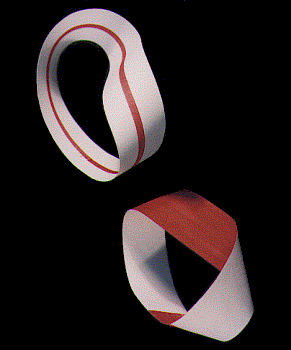
The fascinating model described in this article was created by
Augustus M\"obius (1790 - 1868), a German mathematician and
astronomer.
Here is a limerick describing the properties of the M\"obius
band:
"A mathematician once confided
Old M\"obius' band is always one sided
If you want a good laugh
Cut the band in half
Notice, it stays in one piece when divided.''
(Source unknown)
You need:
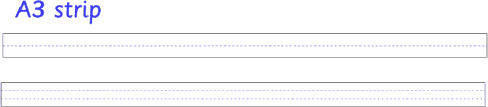
$\bullet$ four long strips of paper, strips of A3 about 30mm wide
are ideal.
$\bullet$ to draw in a centre line along each strip.
$\bullet$ some glue or sellotape and a pair of scissors.
Model A : Take a strip
and glue the ends together.
Model B : Take a strip
and at one end make a half twist ($180^{\circ}$). Glue the ends
together.
Model C : Take a strip,
at one end make a full twist ($360^{\circ}$). Glue the ends
together.
Model D : Take a strip,
at one end make three half twists ($540^{\circ}$). Glue the
ends together.
Take each model in turn. Examine it carefully. Predict what
will happen when a cut is made along the centre line.
Cut your models and record your results in the table below:
| MODEL |
NO. OF TWISTS |
CUTTING PRODUCES |
DESCRIPTION |
| A |
0 |
2 separate strips |
half width/same length |
| B |
1/2 |
|
|
| C |
1 |
|
|
| D |
1 1/2 |
|
|
Can you predict what `shape' results for any number of half
twists?
What about 6 half twists? 10 half twists?
You might like to investigate models based on a M\"obius strip
which has two or more lines to cut along.
What next? ...
This work on the M\"obius band can be followed by an
investigation into Euler's law.
Leonhard Euler (1707 - 1783), was a Swiss mathematician who is
possibly best remembered for a rule he found that worked
equally well with networks and polyhedra.
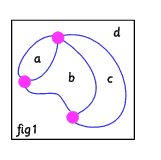
A network is a collection of vertices (dots) connected by arcs
(lines) that create regions (spaces) in between.
This network has 3 nodes, 5 arcs and 4 regions. The outside is
counted also.
Study the networks below and complete the table
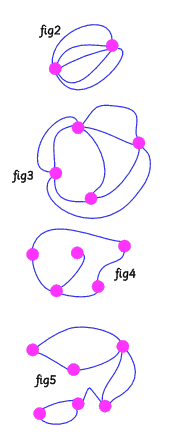
| FIGURE | NODES | REGIONS | ARCS |
| 1 | 3 | 4 | 5 |
| 2 | | | |
| 3 | | | |
| 4 | | | |
| 5 | | | |
\begin{tabular}{|l|l|l|l|} \hline FIGURE & NODES &
REGIONS & ARCS \\ \hline 1 & 3 & 4 & 5 \\ \hline
2 & \; & \; & \; \\ \hline 3 & \; & \; &
\; \\ \hline 4 & \; & \; & \; \\ \hline 5 & \;
& \; & \; \\ \hline \end{tabular}
What do you notice about the information in this table?
Does you observation always work?
Can you find a network which does not fit in with your
conclusions?
Would your observations still hold true if you had drawn the
networks above on a ball or an inner-tube?
For homework
The Bridges of Koenigsburg would just about provide the
balance of activity that would expand insight into this aspect of
space.