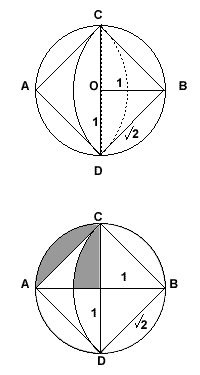
The shaded area is 2 cm2.
Let O be the centre of the circle and let the points where the
arcs meet be C and D respectively. ABCD is a square since its
sides are all equal to the radius of the arc CD and ÐACB = 90° (angle in a semicircle).
In triangle OCB, CB2 = OC2 + OB2; hence CB = Ö2 cm.
The area of the segment bounded by arc CD and diameter CD is
equal to the area of sector BCD - the area of triangle BCD, i.e.
æ ç
è
14
p(Ö2)2 -
12
×Ö2 ×Ö2
ö ÷
ø
cm2
The unshaded area in the original figure is, therefore, (p-2)cm2. Now the area of the circle is pcm2 and hence the
shaded area is 2 cm2.
Note that the shaded area is equal to the area of square ABCD.
This can be proved by showing that the areas of the two regions
shaded in the lower diagram are equal. This is left as a task for
the reader.