Did you know that fractions as we use them today didn't exist in
Europe until the 17th century? In fact, at first, fractions
weren't even thought of as numbers in their own right at all,
just a way of comparing whole numbers with each other. Who first
used fractions? Were they always written in the same way? How did
fractions reach us here? These are the sorts of questions which
we are going to answer for you. Read on ...
The word fraction actually comes from the Latin "fractio" which
means to break. To understand how fractions have developed into
the form we recognise, we'll have to step back even further in
time to discover what the first number systems were like.
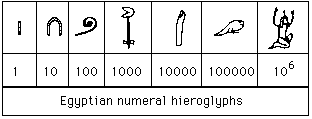
From as early as 1800 BC, the Egyptians were writing fractions.
Their number system was a base $10$ idea (a little bit like ours
now) so they had separate symbols for $1$, $10$, $100$, $1000$,
$10 000$, $100 000$ and $1 000 000$. The ancient Egyptian writing
system was all in pictures which were called hieroglyphs and in
the same way, they had pictures for the numbers:
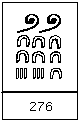
Here is an example of how the numbers
were made up:
Could you write down $3 581$ in hieroglyphics?
The Egyptians wrote all their fractions using what we call unit
fractions. A unit fraction has $1$ as its numerator (top number).
They put a mouth picture (which meant part) above a number to
make it into a unit fraction. For example:
Here is one fifth.
Can you work out how to write one sixteenth?
They expressed other fractions as the sum of unit fractions, but
they weren't allowed to repeat a unit fraction in this addition.
For example this is fine:
$${3\over4} = {1\over2} + {1\over4}$ $
But this is not:
$${2\over7} = {1\over7} + {1\over7}$$
The huge disadvantage of the Egyptian system for representing
fractions is that it is very difficult to do any calculations. To
try to overcome this, the Egyptians made lots of tables so they
could look up answers to problems.
In Ancient Rome, fractions were only written using words to
describe part of the whole. They were based on the unit of weight
which was called the as. One "as" was made up of 12 uncia so
fractions were centred on twelfths. For example:
${1\over12}$ was called uncia
${6\over12}$ was called semis
${1\over24}$ was called semuncia
${1\over144}$ was called scripulum
As with the Egyptian system, the words made it very difficult to
do calculations.
The Babylonians were the first people to come up with a more
sensible way of representing fractions. In fact they did this
before the Romans' methods but there was no contact between the
two civilisations. The Babylonians lived in the country we now
call Iraq in the Middle East. Their number system was organised
around the number $60$, so we say it is base $60$. In other words
they grouped numbers into $60$s, whereas we group into $10$s. (We
still use base $60$ in our measurement of time and angles.)
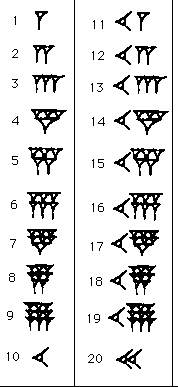
However, they also grouped into $10$s and so only had two
symbols, one for a unit and one for a $10$:
Here are the numbers from $1$ to $20$.
Can you see the symbol for $1$?
What about the symbol for $10$?
How would you write $47$?
The Babylonians simply extended their numbers to include
fractions in sixtieths, as we do for tenths, hundredths etc.
However, they didn't have a zero or anything like a decimal
point. This made reading numbers very confusing as they could be
interpreted in different ways. Here's an example:
From the table above, you can see that the two numbers are
$12$ and $15$. Now, this is where it becomes confusing. This
could mean several different things:
| x60 |
Units |
Sixtieths |
Number |
|
12 |
15 |
$12 + {15\over60} = 12
{15\over60}$ |
| 12 |
15 |
|
720 + 15 |
So, although the Babylonians had a very sophisticated way of
writing fractions, it did have its drawbacks. Around 311BC they
devised a zero so this made things easier, but without a decimal
point, it was still difficult to distinguish fractions from whole
numbers. We are now reaching the end of our journey through the
history of fractions! The format we know today comes directly
from the work of the Indian civilisation. The success of their
way of writing fractions is due to the number system they created
which has three main ideas:
i) Each figure has a symbol which isn't like the value it
represents
ii) The value of the figure depends on the position of it within
the entire number
iii) A zero is needed to mean nothing and also to fill the place
of units that are missing
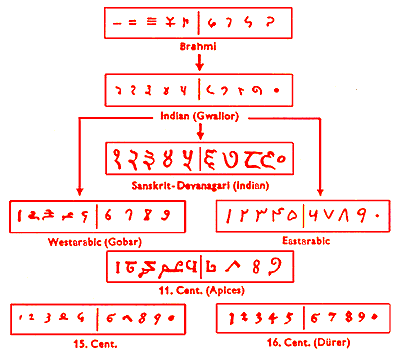
By about 500AD, the Indians had developed a system from a way of
writing called brahmi, which had nine symbols and a zero. Again,
this was devised a long time before some of the other ways of
counting we have already discussed. However it was only through
the trading of the Arabs that these Indian numerals were spread
to Arabia where they were used in the same form. The chart below
shows how these brahmi symbols became the numbers we know
today:
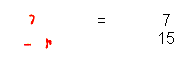
In India fractions were written very much
like we do now, with one number (the numerator) above another
(the denominator), but without a line. For example:
It was the Arabs who added the line (sometimes drawn
horizontally, sometimes on a slant) which we now use to
separate the numerator and denominator:
So here we have the fraction as we now recognise it. It is
amazing to think how much thought has gone into the way we write
it down, isn't it? Perhaps next time you use fractions, you'll
remember this.
All images reproduced by kind permission from http://turnbull.mcs.st-and.ac.uk/history/
.
If you'd like to know more, check out these websites:
http://www-netra.ics.uci.edu/~eppstein/numth/egypt/
http://www-groups.dcs.st-and.ac.uk
http://www.math.buffalo.edu/mad/Ancient-Africa/
http://members.aol.com/jeff570/
http://www.gosai.com
"The Universal History of Numbers" by Georges Ifrah, published by
Harvill, is also a fantastic source of information.
Perhaps you could find out about other civilisation's number
systems.For information on the Greeks try:
http://www.math.tamu.edu/~dallen/history/gr_count/gr_count.html
And for Chinese numerals look at:
http://www.saxakali.com/color_asp/chinamh1.htm
The Mayan number system is also interesting:
http://www.saxakali.com/historymam2.htm