There were a number of partial solutions but
this well explained one is almost entirely the work ofAndrei of
Tudor Vianu National College and shows how "obvious" the answer
is with a little visualising and careful reasoning.
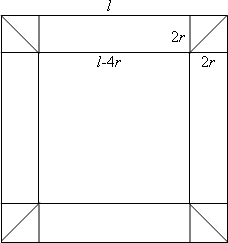
Let l be the exterior length of the cylinders and r - the radius of the
cylinders.
In the first solution, I have 4 cylinders (the 4 squares length l-4r and
2r) and 8 half-cylinders - cylinders cut through the diagonal (the 8 small
right-angled triangles from the figure).
Each of the four cylinders has the volume:
V1 = pr2 (l - 4r)
Each of the half-cylinders has a volume of half a cylinder:
Now, the total volume of the tubular stand is:
V = 4 ×V1 + 8 ×V2 = 4pr2 (l - 2r)
With the second method, I arrange the 8 half-cylinders to make 4 bigger
cylinders, and these 4 to the bigger ones. The height of one 'big' cylinder is (l - 2r), and the total volume is:
V = 4 pr2 (l - 2r)
which is exactly the result obtained above.
Substituting the numerical values: l = 10 cm and r = .5 cm, I obtain:
V = 4 p×0.25 ×(10 - 1) = 9 p = 28.27 cm3
If the volume wood would be double (18 p), then the outside dimension
of the dowel would be:
If the volume of wood would be the same but the radius would be 1 cm,
then the outside dimension would be:
The general formula for the volume of the dowel (proved above) is:
V = 4 pr2 (l - 2r)
One could see that the volume is proportional to the square of the radius,
and in the limit of long outside dimensions, proportional to the outside dimension.