Vectors - What Are They? gives an introduction to the
subject.
There are two useful definitions of multiplication of vectors, in
one the product is a scalar and in the other the product is a
vector. There is no operation of division of vectors. In some
school syllabuses you will meet scalar products but not vector
products but we discuss both types of multiplication of vectors in
this article to give a more rounded picture of the basics of the
subject
Scalar Multiplication
The scalar product of
vectors
and
is a scalar defined to be
This is sometimes called the inner product or dot
product. It follows immediately from the definition that
and if
are unit vectors along the axes then
It is left to the
reader to check from the definition that
This shows that we can expand or multiply out
giving nine terms. Using equation (3) six of these terms are
zero and the other three give the expression
consistent with the definition in equation
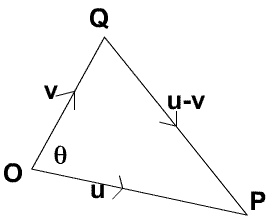
(1). The Cosine Rule in Euclidean Geometry can be proved
without the use of scalar products. Using the Cosine Rule for the
triangle
where
we get:
Expanding
we get
Hence, from equations (4) and (5), we get the very
useful result
where angle
is the angle between the vectors
and
. This is a very important and useful result because
it enables us to find the angle between two vectors.
Some texts use the formula (6) to define the angle between two
vectors, that is
In three dimensions we can use a more intuitive
definition of angle in terms of turning, but in higher dimensions
it is necessary to have a definition of angle such as formula (7).
If we use this formula to define an angle then the Cosine Rule
follows directly as the two are equivalent.
Note that the product of a row vector and a column vector is
defined in terms of the scalar product and this is consistent with
matrix multiplication.
Vector Multiplication
The vector product of two vectors
and
,
written
(and sometimes called the
cross product), is the vector
There is an alternative definition of the vector product, namely
that
is a vector of magnitude
perpendicular to
and
and obeying the 'right hand rule', and we shall prove that this
result follows from the given definition and that the two
definitions are equivalent. The proof is given later for
completeness but first we consider
expressed in terms of components in the directions of
.
From this definition we can see that
so this operation is not commutative. If
are unit vectors along the axes then, from this
definition:
and
From the definition it follows
that
Expanding the
expression
gives
which is the formula for the
vector product given in equation (8).
Now we prove that the two definitions of vector multiplication are
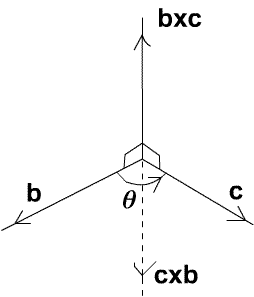
equivalent. The diagram shows the directions of the vectors
,
and
which form a 'right
handed set'.
You may wish to finish reading here and it is indeed more
important to appreciate that there are two definitions of a vector
product, which can be shown to be equivalent, than it is
mechanically to work through the details of the proof.
Theorem The vector product of two vectors
and
is a vector
with the following
properties: (i)
has magnitude
where
is the angle
between the directions of
and
;
(ii)
is perpendicular to
and
with direction such that the vectors
,
and
form a right handed set as in the
diagram so that
and
are in opposite directions.
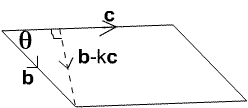
Proof of part (i) Consider the area of the parallelogram
with sides given by the vectors
and
and angle
between these sides. The area of this parallelogram is
. The vector
can be
decomposed into a vector
of magnitude
in the direction of
and
of
magnitude
perpendicular to
where
.
So the area of the parallelogram is:
In order
to work out the modulus on the right hand side we take the scalar
product of the vector with itself.
Proof of part (ii) To show that
and
are perpendicular we show that the scalar
product is zero:
and similarly the
scalar product of
and
is zero so
these vectors are perpendicular.
 Expanding
we get
Expanding
we get