Andrei Lazanu of Tudor Vianu National College, Bucharest, Romania
sent in a very good solution to this problem.
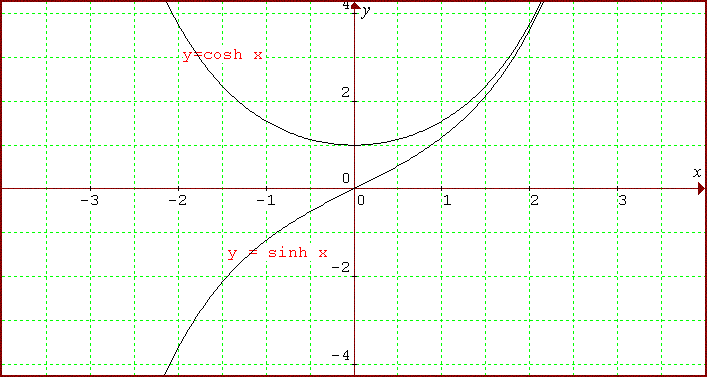
From the definitions
we see that
is always positive, it is an even function
and its derivative is
and
is zero when
so the graph of
is U shaped with a minimum at
, as
this is the only turning point and
increases as
increases for
.
The derivative of
is
so the graph of
is everywhere increasing with the only turning point a point of
inflexion at the origin. As
is an odd function the graph
has rotational symmetry about the origin. Clearly for all
we
have
so the graph of
is below the
graph of
and they get closer as
increases.
1. First, I have to prove that:
. From
the definition
and
so
2. In the second part, I have to prove that:
.
I know that:
and
The two results above are
equal, so I have proved that:
.
3. I have to prove that:
Starting again from the definition, I can write the following
expression for the terms:
4. I have to prove the following inequality:
.
This could be demonstrated using induction. It is clear that for
I obtain an equality, so I look to prove the inequality
for
. Then I shall consider it true for
and prove it
for
.
As
for all
it follows that
for all
so the statement is
true for
and
. Now assume the statement is true for
and consider
. We have, as
is positive
for all
,
and so if
then
and hence by
the axiom of mathematical induction the statement is true for all
positive integers
.