Andrei Lazanu of Tudor Vianu National College, Bucharest, Romania
sent in a very good solution to this problem.
From the definitions
coshx
=
12
(ex + e-x)
sinhx
=
12
(ex - e-x)
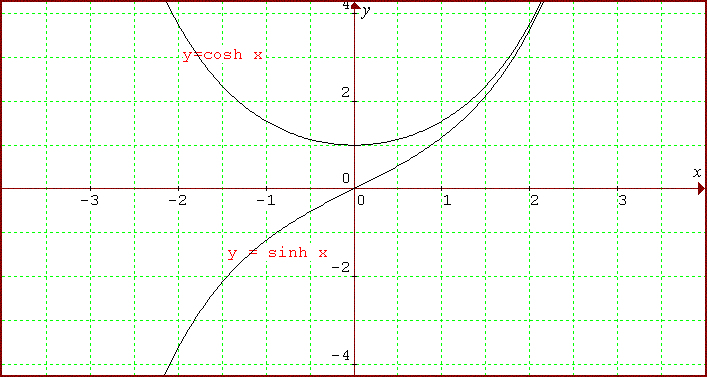
we see that coshx is always positive, it is an even function
and its derivative is sinhx and sinhx is zero when x=0
so the graph of coshx is U shaped with a minimum at (0,1), as
this is the only turning point and coshx increases as x
increases for x > 0.
The derivative of sinhx is coshx so the graph of sinhx
is everywhere increasing with the only turning point a point of
inflexion at the origin. As sinh is an odd function the graph
has rotational symmetry about the origin. Clearly for all x we
have sinhx < coshx so the graph of sinh is below the
graph of cosh and they get closer as x increases.
1. First, I have to prove that: cosh2x - sinh2x = 1. From
the definition coshx + sinhx = ex and coshx - sinhx = e-x so
2. In the second part, I have to prove that: sinh2x = 2sinhx coshx.
I know that:
sinh2x =
12
(e2x - e-2x)
and
2sinhx coshx =
12
(ex - e-x)(ex + e-x)=
12
(e2x-e-2x).
The two results above are
equal, so I have proved that: sinh2x = 2sinhx coshx.
3. I have to prove that:sinh(n+1)x = sinhnx coshx + coshnx sinhx,
Starting again from the definition, I can write the following
expression for the terms:
sinhnx coshx + coshnx sinhx
=
14
[(enx - e-nx)(ex + e-x)+ (enx + e-nx)(ex - e-x)]
=
14
[2e(n+1)x-2e-(n+1)x]
=
12
[e(n+1)x - e-(n+1)x]
= sinh(n+1)x .
4. I have to prove the following inequality: sinhnx ³ n sinhx.
This could be demonstrated using induction. It is clear that for
n = 1 I obtain an equality, so I look to prove the inequality
for n = 2. Then I shall consider it true for n=k and prove it
for (k+1).
As coshx > 0 for all x it follows that sinh 2x = 2sinhx coshx > 2sinhx for all x so the statement is
true for n=1 and n=2. Now assume the statement is true for
n=k and consider sinh(k+1)x. We have, as cosh is positive
for all x,