This solution comes from Andrei Lazanu ,Tudor Vianu National
College, Bucharest, Romania.
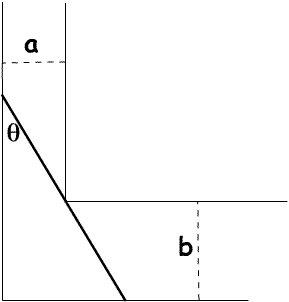
I calculate the length of the stick in terms of a, b and q.
From the figure I observe that the length of the stick could be
seen as the sum of two hypotenuses of two right-angled triangles.
Its length is:
l(q) =
asinq
+
bcosq
.
Now, I have to calculate the minimum of this expression, in order
to make the stick pass through the corner. For this, I calculate
the derivative of l(q) and equate it to 0. I must say from
the beginning that derivatives are not so familiar to me. For a
minimum value of the length:
dldq
=
-acosqsin2 q
+
bsin qcos2 q
=0.
So for a minimum value acos3 q = bsin3 q and
tanq =
æ ç
è
ab
ö ÷
ø
1/3
.
Now, I have to calculate sinq and
cosq as functions of tanq. I know that:
cosx =
1
Ö
1+tan2x
and sinx =
tanx
Ö
1+tan2x
In the case of the problem, I have:
1cosq
=
æ ú
Ö
1+(
ab
)2/3
and
1sinq
= (
ba
)1/3
æ ú
Ö
1+(
ab
)2/3
So the minimum length is
asinq
+
bcosq
=(a2/3b1/3 + b)
æ ú
Ö
a2/3+b2/3b2/3
= (a2/3 + b2/3)3/2
.
The result issymmetric in a and b.
If a=65cm and b=75cm then 652/3+ 752/3=16.16623563 + 17.78446652=33.95070215 and
33.9513/2=197.8213407 so an object of about 197 cm could be
manoeuvred around the bend but it is not possible to manoeuvre a
200 cm object around this bend.