Thank you to Derek Wan and Andrei Lazanu for this solution which
is composed from Derek's written work and Andrei's diagrams.
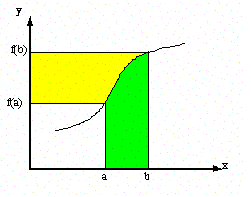
Consider the graph of an arbitrary function
defined over
the interval
. We can see from the diagram that the
rectangle with base
and height
consists of the three
smaller parts: the white part with area
and the
parts shaded yellow and green. The area of the part shaded green
is
. So
In the diagram mark the lines
and
in addition to
and
and reflect the graph of
across the
line
to obtain the inverse function
. Extending
the lines
and
helps us to find
and
the bounds for integration. This gives us the yellow area and thus
the formula:
We can find
by direct integration:
Or we can use the formula with
,
so
and
so
and this is in agreement with the previous
result.
In a similar fashion we find
with
,
so
, and
so
:
Hence
Verification by direct integration:
which is agreement with the previous result.
Editors note: this formula provides a method for carrying out
integration where the function cannot be integrated directly but
the inverse function can be integrated.