Thank you to Derek Wan and Andrei Lazanu for this solution which
is composed from Derek's written work and Andrei's diagrams.
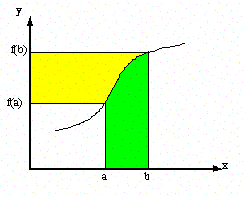
Consider the graph of an arbitrary function y=f(x) defined over
the interval a < x < b. We can see from the diagram that the
rectangle with base b and height f(b) consists of the three
smaller parts: the white part with area bf(b)-af(a) and the
parts shaded yellow and green. The area of the part shaded green
is òabf(x)dx). So
The yellow area+
ó õ
b
a
f(x)dx = bf(b) - af(a).
In the diagram mark the lines y=a and y=b in addition to
y=f(a) and y=f(b) and reflect the graph of y=f(x) across the
line y=x to obtain the inverse function y=f-1(x). Extending
the lines y=a and y=b helps us to find x=f(a) and x=f(b)
the bounds for integration. This gives us the yellow area and thus
the formula:
ó õ
f(b)
f(a)
f-1(t)dt +
ó õ
b
a
f(x)dx = bf(b) - af(a).
We can find ò14Ötdt by direct integration:
ó õ
4
1
Ötdt =
é ê
ë
23
t3/2
ù ú
û
4
1
=
143
.
Or we can use the formula with f(x)=x2,
f(a)=a2=1 so a=1 and f(b)=b2=4 so b=2
ó õ
4
1
Ötdt
= -
ó õ
2
1
x2dx + (2×4 - 1× 1)
= -
é ê
ë
13
x3
ù ú
û
2
1
+7
= -
73
+ 7
=
143
and this is in agreement with the previous
result.
In a similar fashion we find ò01sin-1tdt with
f(x)=sinx, f(a)=sina = 0 so a=0, and f(b)=sinb = 1 so
b = p/2 :
ó õ
1
0
sin-1tdt +
ó õ
p/2
0
sinxdx =
p2
.
Hence
ó õ
1
0
sin-1tdt =
p2
- [-cosx]0p/2 =
p2
-1 .
Verification by direct integration:
ó õ
1
0
sin-1tdt
= [tsin-1t+
____ Ö1-t2
]01
= (1×sin-11+
____ Ö1-12
)-(0× sin-10+
____ Ö1-02
)
=(
p2
+0)- (0+1)=
p2
-1
which is agreement with the previous result.
Editors note: this formula provides a method for carrying out
integration where the function cannot be integrated directly but
the inverse function can be integrated.