Thank you to Roy Madar from Allerton High School and Andrei Lazanu
from Tudor Vianu National College, Bucharest, Romania for their
solutions.
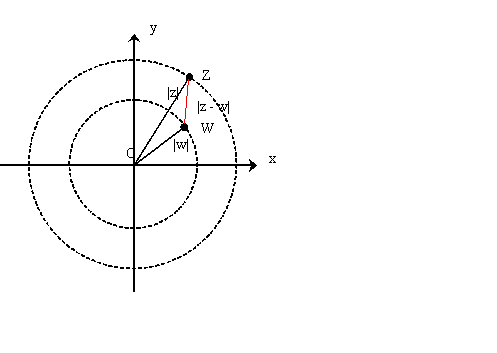
Draw two concentric circles with centres at the origin and radii
and
and suppose, without loss of generality, that
then
lies somewhere on the outer circle and
lies
somewhere on the inner circle.
In this representation, working with complex numbers is similar to
working with vectors. The two complex numbers can be added and
subtracted as vectors. So, to subtract them, it is the same as
adding one to the opposite of the other. The result is represented
in the figure. The distance between the two points representing
the complex numbers
and
is the modulus of
written as
. The lengths of the sides of the triangle in the diagram
are
,
and
.
The shortest distance between any two points where one is on each
circle is given by the difference of the radii of the two circles
. This would be the distance between the points
and
if they had the same argument. If
and
have different
arguments then the distance between the points will be
and hence
.
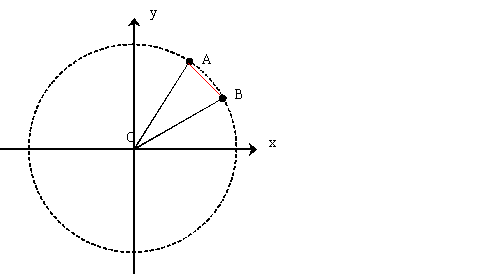
For the second part, mark points
and
on the unit circle to
represent
and
respectively where
and
lie between 0 and
. To include all
possible values of
and
we have
and
for some integers
and
. Clearly
and
also represent
and
The chord length
is less than or equal to the arc length
. Hence