Thank you Andrei Lazanu from Tudor Vianu National College,
Bucharest, Romania for this solution. \par To solve the problem,
I plotted three functions for $0 \leq x \leq \pi/2$. Below are
the graphs of the three functions, all three plotted on the same
figure with $y_1={2x\over \pi}$ in blue, $y_2 = \sin x$ in green
and $y_3=x$ in red. \par 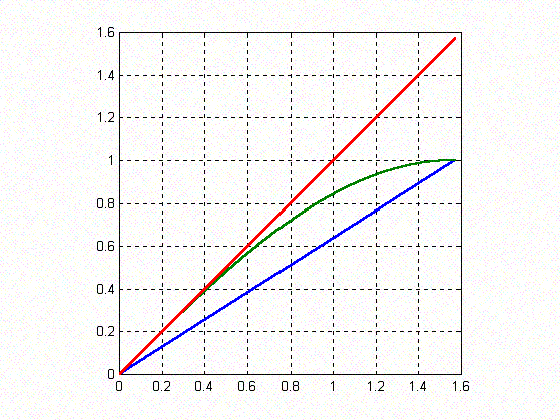
As seen from the figure, the green graph (i.e. y = sinx) is
situated between the other two graphs in the range of 0 £ x £ p/2. For all x between 0 and p/2 the point (x, sin x) is above the point (x, 2x/p) and hence
In this interval the graph of sinx lies below the line y=x
because this line meets the graph of sinx at the origin and
the gradient of sinx is less than 1 for all x. Hence sinx £ x.
For the second part of the problem, I have to prove that:
For any a and b in this interval, both a, b, tana and
tanb are positive, so that the original inequality is
equivalent to the following one:
In the figure below the graph of function y=tanx/x is plotted
for 0 < x < p/2.
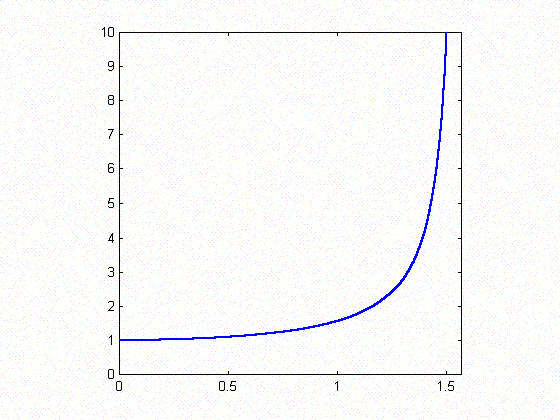
I observe that the function is monotonically increasing. This
means that for any a < b (but remaining in the interval 0 < a < b < p/2), y(a) < y(b) as required.
Alternatively, from the graph of y = tanx in this interval, if
a < b then the gradient of line joining the origin the point
(a, tana) is less than the gradient of the line joining the
origin to the point (b, tanb) so
and hence