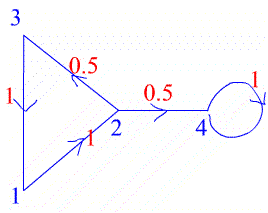
The numbers on the edges of this graph give the probabilities of a
particle travelling along those edges in the direction given by the
arrow. The same information is given by the entry aij in the
following matrix which gives the probability of travelling from
vertex i to vertex j.
A=
æ ç ç
ç ç è
0
1
0
0
0
0
0.5
0.5
1
0
0
0
0
0
0
1
ö ÷ ÷
÷ ÷ ø
.
For this question you can use a graphic calculator or computer
software to find powers of the matrices but you need to understand
the definition of matrix multiplication (see the Thesaurus) to be
able to do the question. Can you see why the square of the
matrix gives the probabilities of travelling from one vertex to
another in two stages and the nth power of the matrix gives the
probability of traveling from one vertex to another in n stages?
For example
A20=
æ ç ç
ç ç è
0
0
0.008
0.992
0.008
0
0
0.992
0
0016
0
0.984
0
0
0
1
ö ÷ ÷
÷ ÷ ø
This matrix shows that there is zero probability of
getting from vertex 1 to vertex 2 in 20 stages (that is along 20
edges with the paths along the edges being repeated), but there is
a probability of 0.008 (to 3 significant figures) of travelling
from vertex 1 to vertex 3 in 20 stages.
Work out A21 and A22 and explain the occurrences of zero
and non zero entries in these matrices.
What would you expect to happen for higher powers, (e.g.
A100), and why?