Yanqing from Lipson Community College and Andrei from Tudor Vianu
National College, Bucharest, Romania both sent correct
solutions.
Andrei wrote: " As I am not familiar with graph theory, I first
read the hint and the notes of the problem, then I looked on the
web for the Maximum flow, minimum cut theorem. I found different
examples, algorithms of solving such problems, as well a possible
list of utilisation.
I started with the definition of terms: a cut in a network is a
minimal set of edges whose removal separates the network into two
components, one containing the source, and the other the sink."
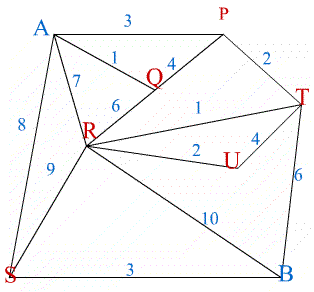
In the first network a cut through $PT$, $RT$, $RU$, $RB$, and
$SB$ separates the network showing that the flow cannot be more
than $18$ units (the total flow through these edges).
This flow is possible by sending: 3 units along ASB, 5 units
along ASRB, 5 units along ARB, 2 units along ARUTB, 1 unit
along AQRTB and 2 units along APTB. Hence the maximum flow is
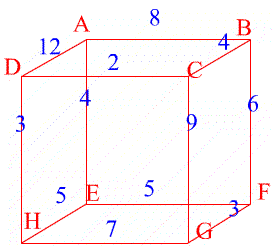
18 units. \par In the second network a cut through BC, DC, FG
and HG separates the network so the flow cannot be more than 16
units (the total flow along these edges).
This flow is possible by sending 3 units along ABFG, 4 units along
ABCG, 2 units along ADCG, 3 units along ADHG and 4 units along
AEHG. Hence the maximum flow is 16 units.