Congratulations Andrei, School No. 205, Bucharest,
Romania on another excellent solution.
1. I observed that a cube could be represented by the diagram
below, that keeps all edges and vertices (the lengths are not
important).
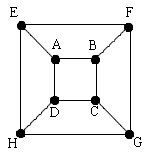
From the beginning I observe that one could start from any vertex
in a cube and there are 8 vertices.
From any vertex there are three possible routes. I shall consider
the routes starting from vertex A.
Below are written all the possible combinations I found starting
with the edge AD:
| Path | Circuit |
| A-D-C-B-F-E-H-G | No |
| A-D-C-B-F-G-H-E-A | Yes |
| A-D-C-G-H-E-F-B-A | Yes |
| A-D-C-G-F - impossible | |
| A-D-H-E-F-B-C-G | No |
| A-D-H-E-F-G-C-B-A | Yes |
| A-D-H-G-C-B-F-E-A | Yes |
| A-D-H-G-F-E - impossible | |
I observe that there are 6 possible paths, 4 of which are
Hamiltonian Circuits. I have to multiply the number of
solutions I obtained. So the total number of solutions is given by
8 * 3 * 6 that is 144, and 96 are Hamiltonian Circuits.
Because all vertices of the cube are indistinguishable, there are
18 solutions, and 12 Hamiltonian Circuits.
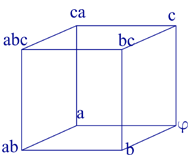
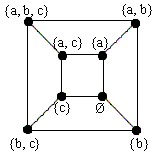
2. Set {a, b, c} has the following subsets: {a, b, c}, {a, b}, {a, c}, {b, c}, {a}, {b}, {c}, f. I observe
that they could be arranged so that one subset is connected with 3
other subsets that differ from the first by only one element,
deleted or inserted. These subsets can be positioned on the
vertices of a cube.
I have verified that each subset is connected with 3 other
subsets, forming a diagram as found before, or, more intuitively,
a cube.
So, the problem is reduced to the first problem. The number of
sequences is 144 sequences, or 18 if the first element of the
sequence does not matter.