Derek Wan gave an excellent solution and we include his diagram of the final result at the end. Here's a solution from Thomas Lauffenberger who finally reveals that he is an American.
Suppose the vector product . Define a sequence of vectors by and Part 1: Show that as if . According to the article supplied on the basics of vector multiplication, the resulting vector is perpendicular to its parents and has a magnitude of . In the problem posed, we are given that is less than 1. The maximum value of is 1, so the product must be less than 1; the magnitudes of the succeeding vectors in the sequence given by decrease as a geometric series, so they will tend to 0 as tends to infinity. The only vector with a magnitude off 0 is the zero vector, which will tend to as tends to infinity. Part 2: Here and . The supplied hint suggests using and . Doing the cross product matrix math (a 3x3 matrix with " " on the top line, "1,0,0" for the line, and "0,r,0" for , we obtain . Performing the next cross product, , we obtain , and, doing it again, . The cross product produces a result of which is ; therefore, we have a cycle. If we begin our movement from the origin in 3-space, tells us to advance r units up the y-axis direction). Then says to advance r units positively along the z-axis. Vectors and , respectively, move again along the y and z axes, but now r units in the negative direction. The shape that follows is a square with sides of r units, located within the yz-plane in this instance. I'm sure that much more can be said about this, regarding our choices for and ; I'll do more work on it and post back more ideas. Addendum to previous submission== The key components determining the location of the square are , a unit vector, and , a vector of magnitude r. Vector determines the plane in which the square will situate itself which has vector perpendicular to the plane of the square; moves within that plane. With the direction vector pointed up relative to our perspective, the motion of the vector is to trace the square in a counterclockwise direction, like a baseball diamond. (Yes, I'm an American!) Thoms is adding one vector onto the previous one to generate a square. Here is Derek Wan's sketch of all 6 vectors: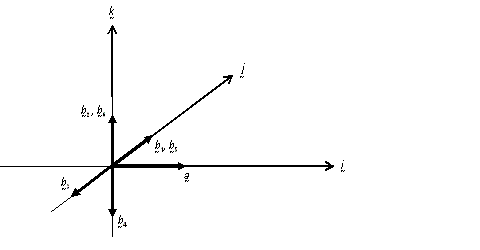
We can see that the vectors lie on the y-z plane perpendicular to the vector .