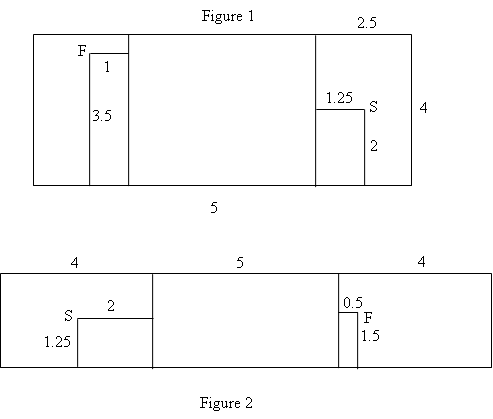
You sent in a large number of solutions to
this problem but many of them only considered the spider moving
horizontally or vertically but not diagonally across the sides of
the room. I have included below a net of the room with the path
of the spider as it takes the shortest route over the ceiling. I
hope it helps you to see what was going on. However the spider
could walk around the walls to get to the fly or along the floor
- risking a human foot!
Andrei of Tudor Vianu National College
calculated the distance the spider must travel in the original
problem and has worked out when it is best to go via the floor
instead of the ceiling.
First, I observed that the shortest distance can be found on
the net of the box.
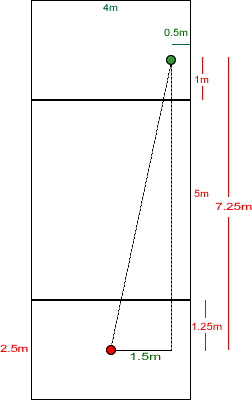
In the figures below, the distances on the box are written, if
the spider travels by the ceiling (figure 1) or by the lateral
wall (figure 2).
In figure 1 - I marked the position of the fly (F), and the
spider (S).
The next step is to calculate the distance travelled by the
spider for each case.
Applying Pythagoras Theorem in Figure 1, I obtain:
FS2 = 7.252 + 1.52
FS = 7.40355 m
In Figure 2, I have:
FS2 = 7.52 + 0.252
FS = 7.50417 m
The shortest distance is 7.40355 m, i.e. the first situation.
This is because the dimension "wide" is larger than the dimension
"high"and the spider starts from the middle of the wall.
Now I analyze the situation when the fly goes down the wall.
In the first case, with the fly fixed, it was situated in the
upper middle of the face, so it was better for the spider to go
on the top of the box. When the fly arrives at the middle
(height) of the box, it is the same for the spider to go over the
top or over the bottom of the box. When the fly goes still
further to the bottom, the spider should go on the bottom of the
box.
However in some cases it is quicker to go
via the side wall instead of either the floor or the ceiling.
Gillian sent us in the following diagrams to help explain how she
worked out when this is the case:
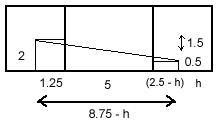
My first diagram shows the measurements when the spider is
crawling along the ceiling. She has to go along (8.75 - h) metres
and down 1.5 metres, so the shortest distance she can travel is
the square root of {(8.75-h)^2 + 1.5^2}. As the height, h, of the
fly decreases, the distance increases.
If she crawls along the floor, the shortest distance she can
travel is the square root of {(6.25+h)^2 + 1.5^2}. As h
descreases, the distance decreases. These two results could be
seen just by common sense.
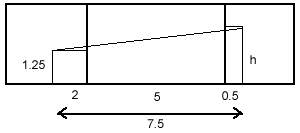
My second diagram shows the measurements when the spider is
crawling along the wall closest to the fly. This way, she goes
along 7.5 metres and up (h - 1.25) metres. The shortest distance
she can crawl is the square root of {(7.5^2 + (h-1.25)^2}.
At h = 1.25 metres, it is quicker for her to crawl along the wall
than either the floor or the ceiling. (Distance = 7.5m, as
opposed to 7.65m if she were going along the floor or
ceiling.)
To see when it's quicker to go along the wall than the ceiling, I
solved the inequality
(8.75 - h)2 + 1.52 ³ 7.52 + (h - 1.25)2 (8.75 - h)2 - (h - 1.25)2 ³ 7.52 - 1.52 7.5*(10 - 2h) ³ 54 h £ 1.4
When the fly is less than 1.4m from the ground, it is quicker to
go by the wall than by the ceiling. Similarly, when it is higher
than 1.1m, it is quicker to go by the wall than the floor.